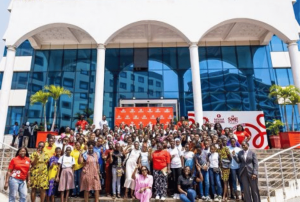


Nearly 40 percent of the skills workers hold today will be obsolete or require major upgrading by 2030, Ghana’s human resource practitioners heard at their annual conference in Accra.
The warning, drawn from the World Economic Forum (WEF) Future of Jobs Report 2025, shaped an address by Esi Mmirba Wilson, Chief Human Resources Officer of MTN Ghana, at the 2026 Chartered Institute of Human Resource Management (CIHRM) Conference. Ms. Wilson told delegates that the disruption reshaping global workforces has reached Ghana, and that the HR profession’s task in this moment is not to administer the fallout but to lead the response.
Her remarks arrived weeks after President John Dramani Mahama launched Ghana’s National Artificial Intelligence (AI) Strategy on April 24, committing the country to a new AI computing centre and directing government ministries to integrate AI tools into public sector operations this year. The One Million Coders Programme, launched in April 2025, aims to give one million Ghanaians digital skills including coding, cybersecurity and AI. HR professionals at the CIHRM conference now face pressure to move faster than the national infrastructure meant to support them.
The scale of the problem is sharper in a regional context. According to the World Bank, only 11 percent of tertiary graduates in Africa south of the Sahara have received formal digital training, even as demand for those competencies surges across key sectors of the economy. The WEF report, drawing on data from more than 1,000 companies, finds that 63 percent of employers now identify the skills gap as their primary barrier to business transformation.
Ms. Wilson described a workplace shifting from fixed job descriptions to models built around skills, where adaptability, continuous learning and the ability to solve unfamiliar problems carry more value than established credentials. She named data literacy, AI fluency, digital agility, critical thinking, adaptive leadership, ethical decision making and communication across cultures as the competencies expected to define workplace success over the next decade.
“Technology alone does not transform organisations. People do,” she said, drawing on MTN Ghana’s nearly three decades of operations as evidence that technology investment without workforce development produces no lasting results.
She urged organisations to abandon the assumption that recruitment can substitute for continuous internal development. The useful life of professional skills is shrinking, and companies that rely on the external hiring market to fill capability gaps will find themselves perpetually behind.
The WEF report projects that job disruption will equate to 22 percent of jobs by 2030, with 170 million new roles set to be created and 92 million displaced, for a net increase of 78 million jobs. For Ghana, whose national AI strategy acknowledges skills shortages, uneven digital infrastructure and risks related to job displacement as the key challenges it must manage, those headline numbers sit within a context of uneven readiness.
Ms. Wilson also pointed to a shift in what employees expect from the organisations they work for. Workers increasingly prioritise meaningful work, career development, flexibility and conditions that support their general wellbeing. The employee value proposition that attracted talent a decade ago is no longer adequate, she said, and businesses that fail to update what they offer will lose skilled people to those that have.
She called on HR practitioners to move beyond their traditional administrative function and operate instead as transformation architects capable of assessing workforce capability, leading digital learning programmes and helping organisations build the resilience that a technology driven economy will demand.
Ghana’s national AI strategy is already encountering the infrastructure constraints and digital literacy gaps that experts flag as key challenges to sustained adoption. The distance between national ambition and organisational readiness is exactly the ground HR professionals are now being asked to close.
Source : www.newsghana.com.gh