
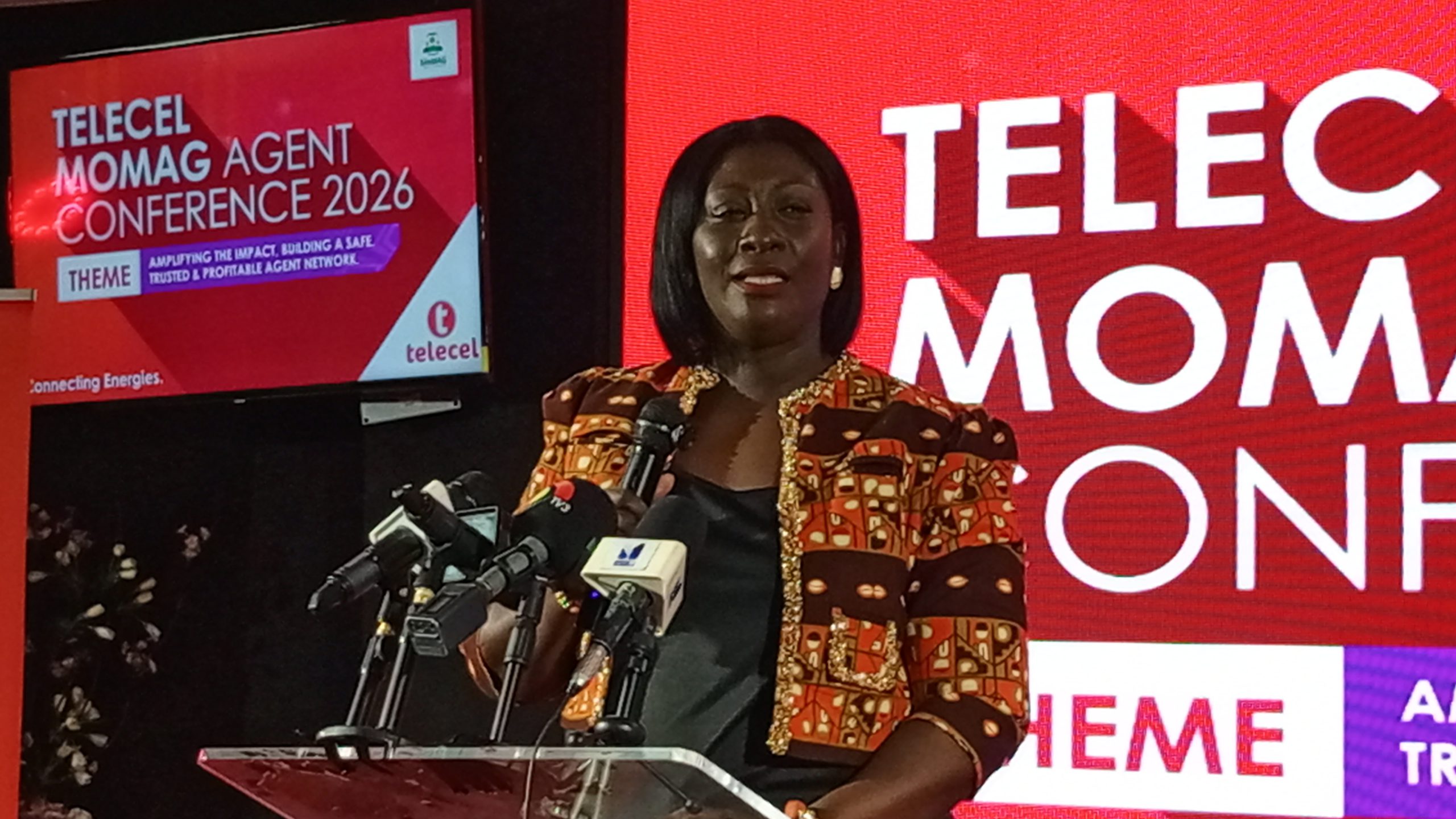
The Chief Executive Officer of the Ghana Chamber of Telecommunications, Sylvia Owusu-Ankomah, has called for a stronger, system-wide approach to digital financial services, warning that Ghana’s leadership in mobile money will only be sustained if trust, security, infrastructure and meaningful financial inclusion remain at the centre of the sector’s growth.
According to her, the foundation of Ghana’s digital-finance success is not merely mobile applications, wallets or technology platforms, but trust, with mobile money agents serving as the human face of that trust in communities across the country.
She made the remarks at the maiden Mobile Money Agents Association of Ghana (MoMAG)/Telecel Capacity Building Forum, where she highlighted the growing importance of mobile money agents to Ghana’s financial and economic infrastructure.
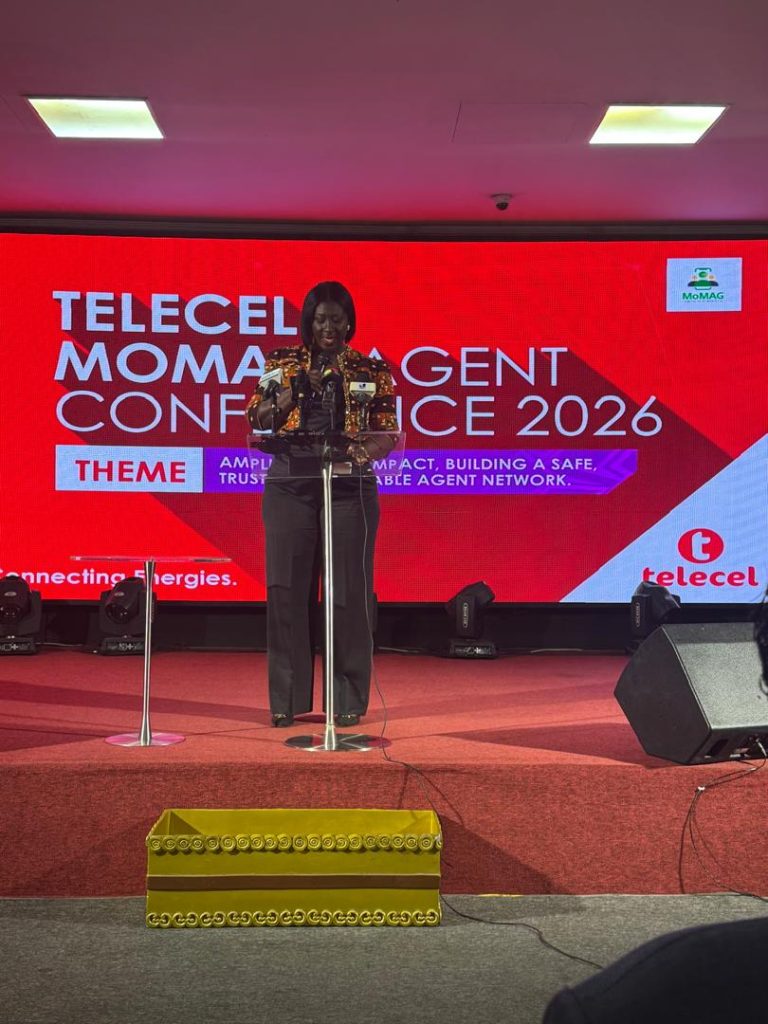
Owusu-Ankomah said the mobile money ecosystem had evolved beyond being a convenient means of transferring funds, stressing that it now plays a critical role in the country’s economic and financial system.
She cited industry figures showing that in 2025, Ghana’s mobile money sector processed approximately 9.7 billion transactions valued at more than GH¢4.5 trillion.
By the end of the year, she said, the country had approximately 26.6 million active mobile money customer accounts and 491,000 active agents.
“These statistics clearly show that mobile money is no longer simply a financial service. It is part of Ghana’s national economic infrastructure,” she said.
She further noted that Ghana retained the top position globally in the GSMA’s 2025 Mobile Money Regulatory Index, describing the achievement as evidence of the country’s strong regulatory foundation, technological innovation and industry collaboration.
However, she cautioned that Ghana’s position as a global leader cannot be taken for granted.
“Leadership is not permanent and is constantly under threat,” she warned, urging stakeholders to focus on the next phase of the country’s digital-finance journey.
Owusu-Ankomah said Ghana must now move beyond simply increasing access to mobile money and focus on ensuring that digital financial services translate into tangible economic opportunities for citizens.
She explained that owning a mobile money wallet does not automatically mean that an individual is financially secure or meaningfully included in the financial system.
“True inclusion means that a market trader can receive affordable credit to expand her business. It means a farmer can insure his produce. It means an informal-sector worker can build a pension. It means an SME can accept payments, keep digital records, build a credit profile and enter the formal economy,” she said.
She therefore called for digital finance to expand beyond sending and receiving money to include access to savings, insurance, pensions, responsible credit, investment, government services and opportunities for enterprise.
A major part of the CEO’s address focused on the changing role of mobile money agents.
She said agents should progressively move beyond their traditional cash-in and cash-out functions and become trusted community financial-service hubs.
With appropriate training, technology and regulatory support, she said agents could facilitate merchant payments, insurance, pensions, remittances, savings products, government payments and other essential financial services.
But she stressed that the expansion of agents’ responsibilities must be matched by greater institutional support.
“Our agents require continuous professional training, stronger business-management skills, reliable liquidity, fair and sustainable commissions, affordable access to capital, appropriate insurance and improved physical security,” she said.
She urged stakeholders to invest in the professional development and welfare of agents, given their growing importance to Ghana’s financial ecosystem.
Owusu-Ankomah also raised concerns about the growing sophistication of fraud in Ghana’s digital-finance ecosystem.
She cited the Bank of Ghana’s 2025 Fraud Report, which recorded 24,124 fraud cases within the payment-service-provider sector, up from 15,673 cases in 2024.
The value at risk, she said, also increased from approximately GH¢19 million to GH¢37 million over the period.
She stressed that the figures should not be interpreted as an argument against digitalisation but rather as a warning that security and public trust must develop at the same pace as digital-finance adoption.
“Fraud does not respect institutional boundaries,” she noted, explaining that a single fraudulent transaction could involve social engineering, compromised identities or SIM cards, mobile money wallets, banks and fintech platforms.
The Telecom Chamber CEO subsequently called for a system-wide national framework capable of bringing together institutions involved in Ghana’s financial and digital-security ecosystem.
She proposed stronger collaboration among banks, electronic money issuers, fintech companies, telecommunications operators, the National Identification Authority, Cyber Security Authority, Ghana Police Service, GhIPSS and the Bank of Ghana.
Such a framework, she said, should facilitate secure sharing of risk signals, real-time fraud detection, rapid freezing of suspicious transactions, common reporting standards and coordinated investigations and recovery efforts.
She disclosed that members of the Digital Chamber were interested in engaging regulators and ecosystem players on the establishment of a National Federated Centralized Fraud Control Centre.
She clarified that the proposal should not involve indiscriminate centralisation of customer data but rather the establishment of secure governance mechanisms that allow institutions to identify and respond to relevant fraud risks before customers lose their funds.
Owusu-Ankomah said mobile money agents should also be fully integrated into the national fraud-prevention architecture because they are often the first people to detect suspicious activities and the first point of contact for customers who have fallen victim to fraud.
She called for simple fraud-reporting channels, clear escalation procedures and regular fraud-awareness training for agents.
At the same time, she said measures must be introduced to protect agents from robbery, impersonation, fraudulent reversals and other operational risks.
“Trust is not the responsibility of the customer alone. It is a shared responsibility across the entire ecosystem,” she emphasised.
The CEO also linked the reliability of Ghana’s telecommunications infrastructure directly to the stability of the country’s digital-finance system.
She explained that every mobile money transaction depends on a network and, behind every digital wallet, are telecommunications towers, fibre connections, data centres, power supply, digital identity systems and payment platforms.
“A financial service cannot be more reliable than the infrastructure supporting it,” she stated.
She therefore called for stronger protection of critical telecommunications infrastructure, improved power reliability, expanded rural network coverage and affordable connectivity.
She also advocated practical measures including Dig Once policies, coordinated infrastructure planning and stronger enforcement against the destruction and vandalism of communications infrastructure.
Owusu-Ankomah further called for Ghana to move beyond basic payment interoperability towards a fully connected digital economy.
She acknowledged that interoperability had already transformed Ghana’s payments landscape by allowing customers to transfer funds between different mobile money wallets as well as between wallets and bank accounts.
However, she said the next phase must make it easier for businesses of all sizes—from major supermarkets to small roadside traders—to accept payments across different platforms.
She said the system should also provide reliable settlement, transparent pricing, open and secure application programming interfaces (APIs), consent-based data sharing and efficient cross-border payments.
According to her, the African Continental Free Trade Area (AfCFTA) provides Ghana with an opportunity to position itself as a gateway for digital trade and financial innovation across Africa.
“A Ghanaian SME should be able to sell across borders, receive payment quickly and securely, and build a credible digital financial history,” she said.
The Telecom Chamber CEO also urged regulators and industry players to ensure that regulation and innovation develop together.
She acknowledged the role of regulatory leadership in Ghana’s digital-finance success but said future regulations must protect consumers and financial stability while allowing responsible innovation to thrive.
She advocated for regulation that is risk-based, proportionate, predictable, technologically neutral and developed through meaningful stakeholder consultation.
She further called for new regulatory requirements to be phased and operationally feasible, with their cumulative impact on customers, agents and industry investment carefully assessed.
Owusu-Ankomah cautioned that the cost of participating in the digital economy must also receive greater attention.
She said taxes, regulatory fees, platform charges, interoperability costs and transaction pricing ultimately determine how much ordinary Ghanaians pay to access digital financial services.
“We should not allow the cost of digital participation to become a new form of exclusion,” she warned.
She also encouraged responsible use of emerging technologies such as artificial intelligence and digital credit.
While AI could improve fraud detection, credit assessment and customer service, and digital credit could extend financing to traditionally underserved groups, she said these innovations must be supported by responsible lending, transparent pricing, strong data protection, explainable decision-making and effective customer-redress mechanisms.
Owusu-Ankomah urged the Mobile Money Agents Association of Ghana (MoMAG) to play a central role in shaping the future of the sector.
She said the association’s advocacy must be accompanied by strong professional standards, accurate record-keeping, regulatory compliance, customer protection and continuous learning.
She urged every agent to view their role beyond transaction processing.
“Every agent must see himself or herself not simply as a transaction processor, but as a custodian of trust and a gateway to economic opportunity,” she said.
She also called on the Bank of Ghana and industry players to maintain constructive engagement with mobile money agents, understand the realities of their businesses and involve them early in decisions that affect their operations.
The CEO concluded by commending Telecel Ghana for partnering with MoMAG to organise the capacity-building workshop.
She expressed hope that similar engagements would be institutionalised to strengthen professionalism, improve service delivery and support sustainable growth within Ghana’s mobile money ecosystem.
“It is my hope that such engagements will be institutionalized for the growth of the industry,” she said, while wishing participants fruitful deliberations.
source : 1960news.com