

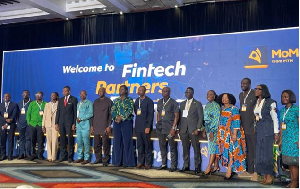
Stakeholders in the digital financial ecosystem are calling for urgent, coordinated action to combat rising digital fraud as attacks become more sophisticated, interconnected and increasingly organised across platforms.
Chief Executive Officer Mobile Money Ltd, Shaibu Haruna, warned that fraud has evolved beyond isolated mobile money incidents into a broader digital crime environment – making it difficult for any single institution to effectively respond.
Recent data illustrate the problem’s magnitude. Ghana’s financial sector recorded 16,733 fraud cases in 2024, according to the Bank of Ghana; meanwhile, cybercrime-related losses exceeded GH¢19million between January and September 2025, data from the Cyber Security Authority show.
Online fraud remains the dominant threat, accounting for about 36 percent of reported cyber incidents.
“It is not a mobile money fraud issue; this is a digital crime environment,” he said, explaining that fraud now cuts across multiple channels including banking systems, e-commerce platforms and messaging applications such as compromised WhatsApp accounts.
According to him, the nature of fraud has shifted significantly in recent years – moving from opportunistic activity to a coordinated network.
“The fraud we are seeing has moved from being an isolated opportunistic event to
being an organised network… you can even add an industry right now,” he said, noting that emerging technologies are further shaping the threat landscape.
He explained that attack points across the ecosystem are interconnected, allowing fraudsters to exploit weaknesses in one channel to target another, particularly payment platforms.
This, he said, underscores the need for deeper collaboration and integration across banks, fintech companies and mobile money operators.
Haruna made these remarks at Mobile Money Fintech Limited’s maiden Fintech Partner Exchange held in Accra, where industry players convened under the theme ‘Uniting Against Fraud: Strengthening Ecosystem Collaboration.
While acknowledging ongoing efforts by institutions to strengthen systems and educate customers, he maintained that current responses remain fragmented and insufficient against the scale and coordination of emerging threats.
“We cannot fight this industry with a silo approach,” he said, adding that disconnected systems limit the industry’s ability to respond effectively to coordinated attacks.
“We cannot fight this industry with a silo approach,” he said, adding that disconnected systems limit the industry’s ability to respond effectively to coordinated attacks.
He therefore urged regulators, banks and fintech partners to work toward a more coordinated framework anchored on collaboration, shared responsibility and stronger engagement with law enforcement agencies.
Haruna also identified customers as a critical point of vulnerability, noting that fraudsters often exploit human behaviour through social engineering tactics.
A panel discussion held as part of the event reinforced concerns about the scale and complexity of fraud across the ecosystem, with stakeholders identifying social engineering, weak transaction monitoring and low customer awareness as key drivers.
The panel noted that fraud often occurs at the intersection of systems, particularly in transactions between bank accounts and mobile wallets where coordination gaps can be exploited. They also highlighted challenges in tracing transactions, as funds can move across multiple platforms within a short period.
They reiterated that existing collaboration mechanisms remain largely informal, limiting the speed and effectiveness of responses. As such, calling for stronger coordination among service providers, financial institutions and law enforcement agencies to improve information sharing and intervention timelines.
Law enforcement representatives stressed the need for enhanced training cybercrime investigators, improved digital forensic capabilities and stronger institutional support for investigations and prosecution.
Panellists further underscored the importance of prevention, noting that customer education, real-time awareness and stronger security controls remain critical first lines of defence.
Chief Executive Officer-Ghana Interbank Payment and Settlement Systems (GhIPSS) Clara Arthur highlighted the role of interoperable systems in detecting suspicious activity and stressed a need for stakeholders to work together on strengthening trust across the ecosystem.
Chief Executive Officer-Ghana Interbank Payment and Settlement Systems (GhIPSS) Clara Arthur highlighted the role of interoperable systems in detecting suspicious activity and stressed a need for stakeholders to work together on strengthening trust across the ecosystem.
Similarly, Chief Executive Officer of the Ghana Chamber of Telecommunications Sylvia Owusu-Ankomah described the discussions as timely, noting that the scale and coordination of fraud now require a unified industry response.
She echoed deeper collaboration across institutions, strengthened capacity within the ecosystem and improved systems to support fraud detection and prevention.
Stakeholders agreed that while digital financial services continue to expand rapidly, the ecosystem’s sustainability will depend on industry players’ ability to collectively address fraud risks and protect users.
The consensus was that translating discussions into coordinated action will be critical to strengthening resilience and maintaining confidence in Ghana’s digital financial system.