
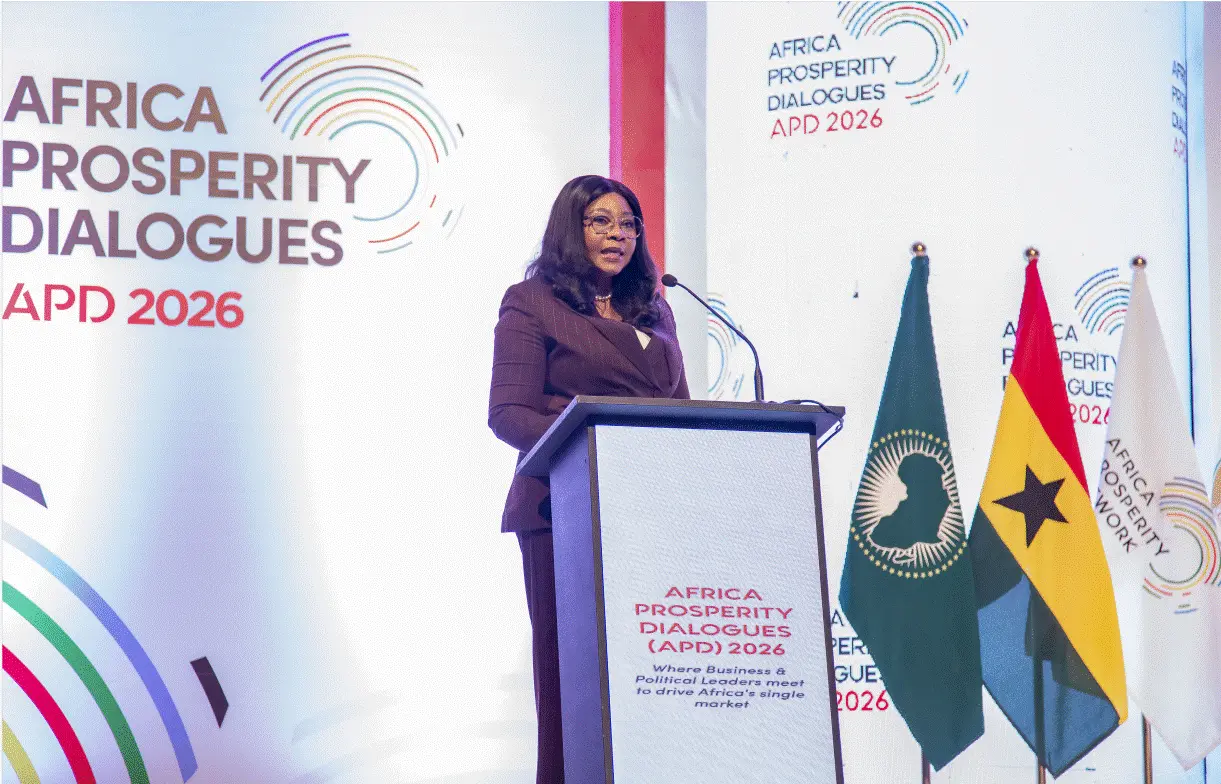
The Second Deputy Governor of the Bank of Ghana (BoG), Mrs Matilda Asante-Asiedu, has said that as Africa advances implementation of the African Continental Free Trade Area, one truth has become increasingly clear, that Trade agreements alone do not create trade, payments make trade possible
Without secure, affordable, and reliable means of transferring value, she said, the promise of a truly integrated African market cannot be achieved. Payment systems are strategic trade infrastructure, essential for monetary stability, financial integration, and long-term economic transformation across our continent.
Speaking at the African Prosperity Dialogue (APD) 2026 on the theme “cross-border payments and digital finance systems in Africa” held in Accra on Wednesday, February 4, she said cross-Border Payments in Africa: Challenges and Opportunities Despite Africa’s enormous economic potential, cross-border payments remain expensive, slow, and fragmented.
“Transaction costs for intra-African payments often exceed 7 to 10 2 PUBLIC percent, compared with a global average of about 3 percent. Settlement times can extend from days to weeks. More than 80 percent of intra-African payments are routed through correspondent banks outside the continent, largely in foreign currencies.
“This costs Africa an estimated US$5.3 billion annually and exposes our economies to foreign exchange risks. Yet, amidst these challenges lie tremendous opportunities. AfCFTA brings together a market of over 1.5 billion people and a combined GDP of approximately US$2.8 trillion,” she said.
If fully implemented, she added, intra-African trade could double in the medium term. But this growth will only materialise if our payment systems match Africa’s trade ambitions.
“Thankfully, Africa has already demonstrated global leadership in digital finance innovation. With more than half of the world’s mobile money accounts, the continent has shown how technology can expand financial inclusion and transform livelihoods, and Ghana stands as a notable example. Digital finance has become a lifeline for households, microenterprises, women, and underserved communities.
“However, much of this progress remains domestic rather than continental. For digital finance to fully empower Africa’s single market, inclusion must extend across borders – not only within them.”
In Ghana, Mrs Asante-Asiedu further said, “We have deliberately built a modern, interoperable, and resilient payment ecosystem. Investments in digital public infrastructure have enabled interoperability across banks, mobile money operators, and fintech institutions, supporting real-time payments across our economy.”
‘These domestic successes provide a strong platform for regional integration,’ she said.
“Ghana is an active participant in the Pan-African Payment and Settlement System – PAPSS, which enables cross-border payments in local African currencies, shortens settlement chains, and lowers costs for African traders. Our vision is clear and deliberate: African trade must increasingly be settled in African currencies, through African infrastructure, and supported by African institutions. Central banks play a vital role in fostering innovation, while safeguarding financial stability and public confidence.
“At the Bank of Ghana, we are advancing key initiatives, including • Fintech Passporting, through collaboration with the National Bank of Rwanda, to enable cross-border licensing and regulatory trust. This is a solution that can be scaled across the continent. • Our Africa Next-Generation Digital Public Infrastructure Initiative is testing multilateral interoperability frameworks, settlement models, and future cross-border digital currency arrangements. • The Virtual Asset Service Providers Act, recently passed by Ghana’s parliament, is designed to support emerging digital payment channels while ensuring strong consumer protection and risk oversight.
“These initiatives recognise that payment systems constitute critical national and continental infrastructure requiring robust cybersecurity, regulatory coordination, and trusted governance frameworks.”
Source: 3News