MTN Ghana has announced plans to invest US$1.1 billion in its network over the next three years, including about US$380 million in 2026, as the company marks its 30th anniversary.
The announcement was made by Chief Enterprise Officer Angela Mensah-Poku during an Ashanti Regional Media and Stakeholder Engagement in Kumasi. The investment will focus on expanding network capacity, improving service quality and strengthening infrastructure resilience.
MTN also highlighted its sustainability commitment, including a target to achieve net-zero emissions by 2040 through cleaner and more energy-efficient technologies.
The stakeholder engagement brought together representatives from the NCA, EPA, Ghana Highways Authority, Ghana Police Service and GJA, alongside media practitioners, to discuss network investment, customer experience and digital inclusion.
MTN Ghana said the investment forms part of its broader commitment to supporting Ghana’s digital and economic development under its 30th anniversary theme, “30 Years of Progress, Powered by You.”
The Chief Executive Officer of the Ghana Chamber of Telecommunications, Sylvia Owusu-Ankomah, has called for a stronger, system-wide approach to digital financial services, warning that Ghana’s leadership in mobile money will only be sustained if trust, security, infrastructure and meaningful financial inclusion remain at the centre of the sector’s growth.
According to her, the foundation of Ghana’s digital-finance success is not merely mobile applications, wallets or technology platforms, but trust, with mobile money agents serving as the human face of that trust in communities across the country.
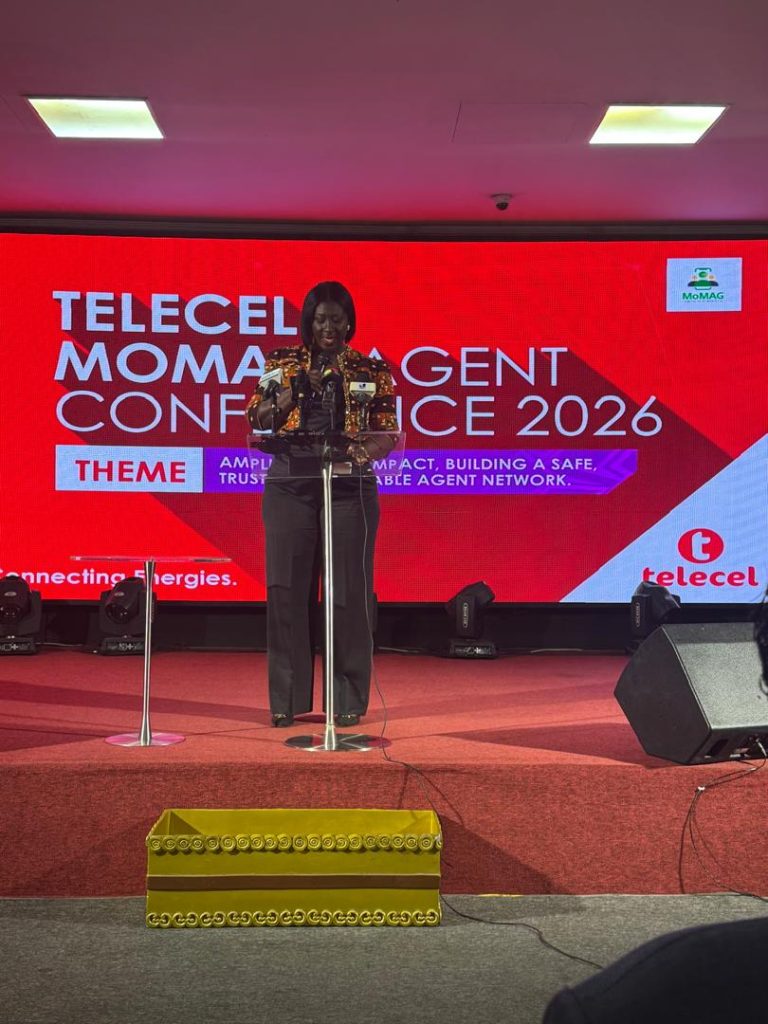
She made the remarks at the maiden Mobile Money Agents Association of Ghana (MoMAG)/Telecel Capacity Building Forum, where she highlighted the growing importance of mobile money agents to Ghana’s financial and economic infrastructure.
Owusu-Ankomah said the mobile money ecosystem had evolved beyond being a convenient means of transferring funds, stressing that it now plays a critical role in the country’s economic and financial system.
She cited industry figures showing that in 2025, Ghana’s mobile money sector processed approximately 9.7 billion transactions valued at more than GH¢4.5 trillion.
By the end of the year, she said, the country had approximately 26.6 million active mobile money customer accounts and 491,000 active agents.
“These statistics clearly show that mobile money is no longer simply a financial service. It is part of Ghana’s national economic infrastructure,” she said.
She further noted that Ghana retained the top position globally in the GSMA’s 2025 Mobile Money Regulatory Index, describing the achievement as evidence of the country’s strong regulatory foundation, technological innovation and industry collaboration.
However, she cautioned that Ghana’s position as a global leader cannot be taken for granted.
“Leadership is not permanent and is constantly under threat,” she warned, urging stakeholders to focus on the next phase of the country’s digital-finance journey.
Owusu-Ankomah said Ghana must now move beyond simply increasing access to mobile money and focus on ensuring that digital financial services translate into tangible economic opportunities for citizens.
She explained that owning a mobile money wallet does not automatically mean that an individual is financially secure or meaningfully included in the financial system.
“True inclusion means that a market trader can receive affordable credit to expand her business. It means a farmer can insure his produce. It means an informal-sector worker can build a pension. It means an SME can accept payments, keep digital records, build a credit profile and enter the formal economy,” she said.
She therefore called for digital finance to expand beyond sending and receiving money to include access to savings, insurance, pensions, responsible credit, investment, government services and opportunities for enterprise.
A major part of the CEO’s address focused on the changing role of mobile money agents.
She said agents should progressively move beyond their traditional cash-in and cash-out functions and become trusted community financial-service hubs.
With appropriate training, technology and regulatory support, she said agents could facilitate merchant payments, insurance, pensions, remittances, savings products, government payments and other essential financial services.
But she stressed that the expansion of agents’ responsibilities must be matched by greater institutional support.
“Our agents require continuous professional training, stronger business-management skills, reliable liquidity, fair and sustainable commissions, affordable access to capital, appropriate insurance and improved physical security,” she said.
She urged stakeholders to invest in the professional development and welfare of agents, given their growing importance to Ghana’s financial ecosystem.
Owusu-Ankomah also raised concerns about the growing sophistication of fraud in Ghana’s digital-finance ecosystem.
She cited the Bank of Ghana’s 2025 Fraud Report, which recorded 24,124 fraud cases within the payment-service-provider sector, up from 15,673 cases in 2024.
The value at risk, she said, also increased from approximately GH¢19 million to GH¢37 million over the period.
She stressed that the figures should not be interpreted as an argument against digitalisation but rather as a warning that security and public trust must develop at the same pace as digital-finance adoption.
“Fraud does not respect institutional boundaries,” she noted, explaining that a single fraudulent transaction could involve social engineering, compromised identities or SIM cards, mobile money wallets, banks and fintech platforms.
The Telecom Chamber CEO subsequently called for a system-wide national framework capable of bringing together institutions involved in Ghana’s financial and digital-security ecosystem.
She proposed stronger collaboration among banks, electronic money issuers, fintech companies, telecommunications operators, the National Identification Authority, Cyber Security Authority, Ghana Police Service, GhIPSS and the Bank of Ghana.
Such a framework, she said, should facilitate secure sharing of risk signals, real-time fraud detection, rapid freezing of suspicious transactions, common reporting standards and coordinated investigations and recovery efforts.
She disclosed that members of the Digital Chamber were interested in engaging regulators and ecosystem players on the establishment of a National Federated Centralized Fraud Control Centre.
She clarified that the proposal should not involve indiscriminate centralisation of customer data but rather the establishment of secure governance mechanisms that allow institutions to identify and respond to relevant fraud risks before customers lose their funds.
Owusu-Ankomah said mobile money agents should also be fully integrated into the national fraud-prevention architecture because they are often the first people to detect suspicious activities and the first point of contact for customers who have fallen victim to fraud.
She called for simple fraud-reporting channels, clear escalation procedures and regular fraud-awareness training for agents.
At the same time, she said measures must be introduced to protect agents from robbery, impersonation, fraudulent reversals and other operational risks.
“Trust is not the responsibility of the customer alone. It is a shared responsibility across the entire ecosystem,” she emphasised.
The CEO also linked the reliability of Ghana’s telecommunications infrastructure directly to the stability of the country’s digital-finance system.
She explained that every mobile money transaction depends on a network and, behind every digital wallet, are telecommunications towers, fibre connections, data centres, power supply, digital identity systems and payment platforms.
“A financial service cannot be more reliable than the infrastructure supporting it,” she stated.
She therefore called for stronger protection of critical telecommunications infrastructure, improved power reliability, expanded rural network coverage and affordable connectivity.
She also advocated practical measures including Dig Once policies, coordinated infrastructure planning and stronger enforcement against the destruction and vandalism of communications infrastructure.
Owusu-Ankomah further called for Ghana to move beyond basic payment interoperability towards a fully connected digital economy.
She acknowledged that interoperability had already transformed Ghana’s payments landscape by allowing customers to transfer funds between different mobile money wallets as well as between wallets and bank accounts.
However, she said the next phase must make it easier for businesses of all sizes—from major supermarkets to small roadside traders—to accept payments across different platforms.
She said the system should also provide reliable settlement, transparent pricing, open and secure application programming interfaces (APIs), consent-based data sharing and efficient cross-border payments.
According to her, the African Continental Free Trade Area (AfCFTA) provides Ghana with an opportunity to position itself as a gateway for digital trade and financial innovation across Africa.
“A Ghanaian SME should be able to sell across borders, receive payment quickly and securely, and build a credible digital financial history,” she said.
The Telecom Chamber CEO also urged regulators and industry players to ensure that regulation and innovation develop together.
She acknowledged the role of regulatory leadership in Ghana’s digital-finance success but said future regulations must protect consumers and financial stability while allowing responsible innovation to thrive.
She advocated for regulation that is risk-based, proportionate, predictable, technologically neutral and developed through meaningful stakeholder consultation.
She further called for new regulatory requirements to be phased and operationally feasible, with their cumulative impact on customers, agents and industry investment carefully assessed.
Owusu-Ankomah cautioned that the cost of participating in the digital economy must also receive greater attention.
She said taxes, regulatory fees, platform charges, interoperability costs and transaction pricing ultimately determine how much ordinary Ghanaians pay to access digital financial services.
“We should not allow the cost of digital participation to become a new form of exclusion,” she warned.
She also encouraged responsible use of emerging technologies such as artificial intelligence and digital credit.
While AI could improve fraud detection, credit assessment and customer service, and digital credit could extend financing to traditionally underserved groups, she said these innovations must be supported by responsible lending, transparent pricing, strong data protection, explainable decision-making and effective customer-redress mechanisms.
Owusu-Ankomah urged the Mobile Money Agents Association of Ghana (MoMAG) to play a central role in shaping the future of the sector.
She said the association’s advocacy must be accompanied by strong professional standards, accurate record-keeping, regulatory compliance, customer protection and continuous learning.
She urged every agent to view their role beyond transaction processing.
“Every agent must see himself or herself not simply as a transaction processor, but as a custodian of trust and a gateway to economic opportunity,” she said.
She also called on the Bank of Ghana and industry players to maintain constructive engagement with mobile money agents, understand the realities of their businesses and involve them early in decisions that affect their operations.
The CEO concluded by commending Telecel Ghana for partnering with MoMAG to organise the capacity-building workshop.
She expressed hope that similar engagements would be institutionalised to strengthen professionalism, improve service delivery and support sustainable growth within Ghana’s mobile money ecosystem.
“It is my hope that such engagements will be institutionalized for the growth of the industry,” she said, while wishing participants fruitful deliberations.
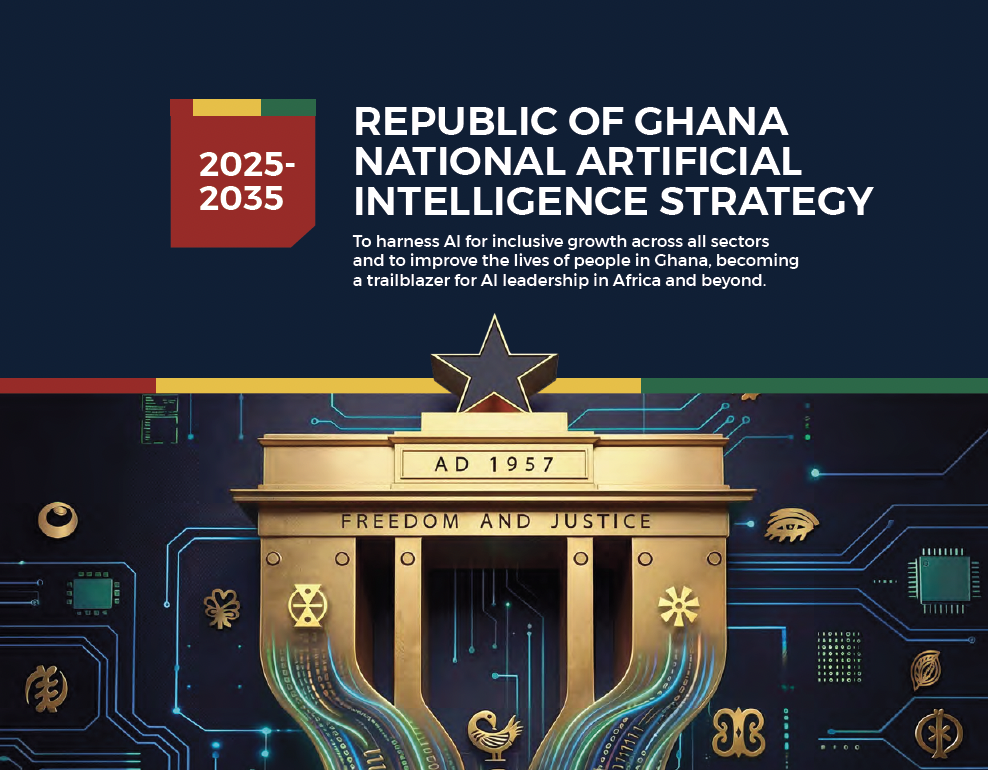
Ghana wants artificial intelligence to become a new engine of economic growth, with its National Artificial Intelligence Strategy targeting applications across healthcare, agriculture, education, public services and industry.
But one of the biggest obstacles to that ambition is not necessarily a shortage of algorithms, computing power or data.
It is something much more physical: fibre cables being repeatedly cut across the country.
Fibre networks form the backbone of the digital economy. They connect businesses, government institutions, mobile networks, data centres and international gateways. When those networks are damaged, the consequences can extend well beyond a temporary telecommunications outage.
Businesses can lose connectivity. Mobile-money services can be disrupted. Government platforms can become inaccessible. Schools and hospitals can be affected. As more services incorporate artificial intelligence, those systems will increasingly depend on the same underlying networks.
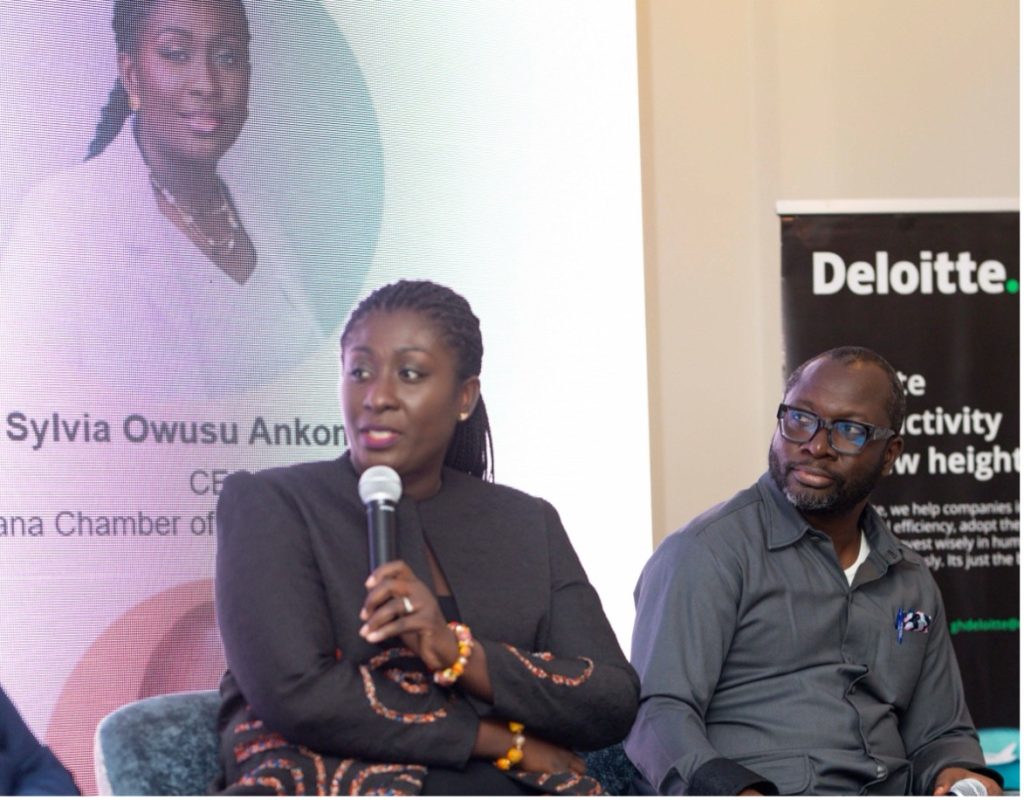
“AI does not replace infrastructure, it depends on it,” Sylvia Owusu-Ankomah, CEO of the Ghana Chamber of Telecommunications, said recently at a Conversations with Equinix forum.
(MS. Sylvia Owusu-Ankomah, CEO of the Ghana Chamber of Telecommunications)
That infrastructure is under growing pressure.
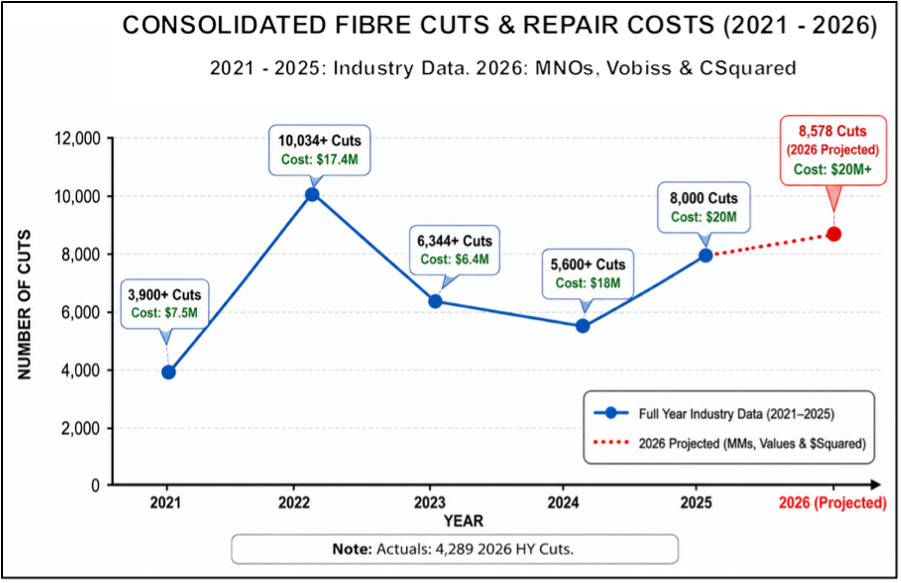
Between 2021 and 2025, telecommunications operators recorded thousands of fibre cuts annually. Incidents rose from 3,900 cuts in 2021, costing about US$7.5 million in repairs, to 10,034 cuts in 2022, costing US$17.4 million.
Although the number fell to 6,344 cuts in 2023 and 5,600 in 2024, cuts exceeded 8,000 in 2025, with direct repair costs reaching approximately US$20 million. And the problem persists. Industry data for the first half of 2026 indicates that reported cuts have already reached 4,289, putting the annual total on pace to exceed 8,000 if no drastic intervention is made to address these fibre cut incidents.
Across the five years (2021 – 2025), operators spent more than $69 million repairing damaged fibre.
That is money that could otherwise have supported network expansion, improved service quality, increased data-centre capacity or helped finance the infrastructure required for Ghana’s AI ambitions.
The problem is particularly pressing as Ghana expands its physical infrastructure.
Road construction involves excavation, drainage and utility relocation, precisely the activities that can damage buried telecommunications networks when projects are not properly coordinated. Aerial fibre mounted on poles is also vulnerable to construction activity.
The telecommunications industry is not arguing against road development. It is arguing that physical and digital infrastructure need to be planned together.
That means knowing where existing fibre is located before excavation begins, engaging network operators and relevant coordinating institutions, and designing future infrastructure to accommodate digital networks.
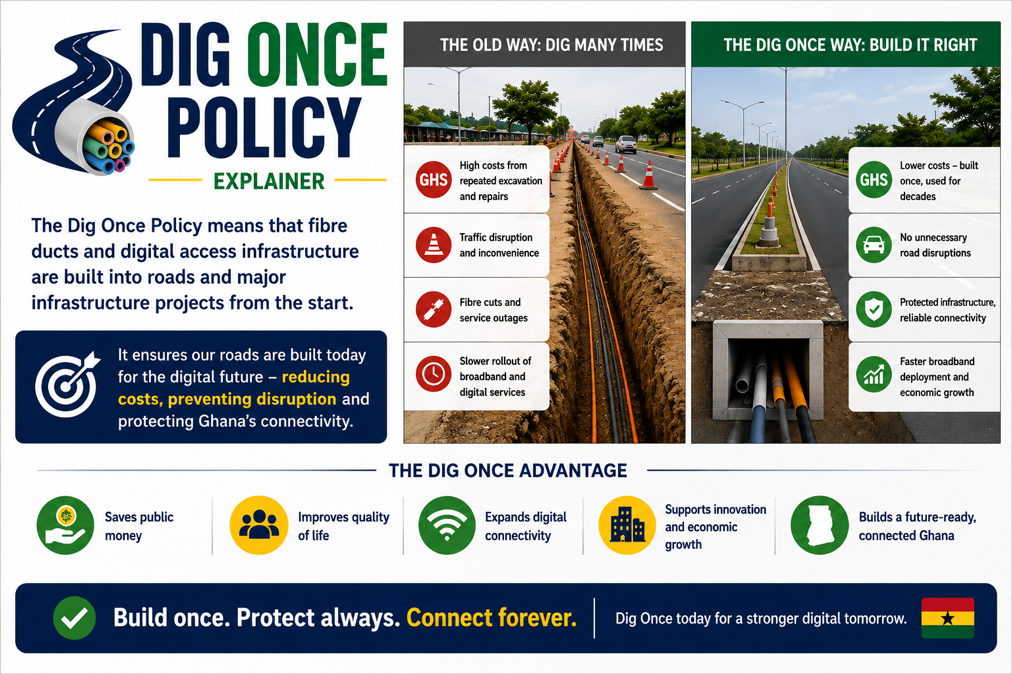
The proposed Dig OncePolicy approach offers one potential solution. Under the proposal, empty fibre ducts and other digital infrastructure would be incorporated into the design of new roads and major rehabilitation projects.
The logic is simple: build the road once, and prepare it for the digital infrastructure the economy will need tomorrow.
Ghana’s AI strategy gives the country an opportunity to position itself in the global digital economy. But policy ambition alone cannot deliver that future.
AI needs data centres, cloud infrastructure, electricity, international connectivity and resilient communications networks.
The choice, therefore, should not be between roads and fibre.
Ghana needs both.
And protecting the infrastructure already in the ground may prove just as important as building what comes next.
Huawei South Africa is inviting women entrepreneurs to join the 2026 edition of its Women in Tech digital skills training programme, aimed at equipping small business owners with practical technology skills to grow and scale their businesses.
Now in its sixth year, the three-day programme will run from August 26 to 28 at Huawei South Africa’s Johannesburg campus under the theme “HERabytes: Small Business.” Participants will receive training in emerging technologies including 5G-A, cloud computing and artificial intelligence (AI), with a focus on applying these tools to everyday business operations.
Huawei said the programme is designed to make AI more practical and accessible to women entrepreneurs, helping them integrate tools such as automation, cloud solutions and smarter customer engagement into their businesses. The programme is being delivered in partnership with South Africa’s Department of Communications and Digital Technologies and Henley Business School Africa.
The final day will focus on leadership, business resilience and strategic adaptability, with participants who complete the full programme receiving certificates.
Helios Towers has raised its full-year 2026 guidance following strong performance in the first half of the year, driven by new tower builds and tenant additions across its African and Middle Eastern markets.
The company added 755 new sites over the past year, including 524 in the first half, bringing its total portfolio to 15,270 towers at the end of Q2 2026.
Total tenancies reached 34,455, representing a 13% year-on-year increase, with significant additions recorded in the DRC, Tanzania and Oman.
For the quarter, revenue rose 11% year-on-year to US$237 million, while Adjusted EBITDA increased 13% to US$130 million.
Helios Towers now expects 3,500–4,000 tenancy additions in 2026, up from 2,538 in 2025. It projects Adjusted EBITDA of US$527 million, recurring free cash flow of US$228 million, and discretionary capital expenditure of approximately US$230 million.
The company said growing smartphone adoption, data consumption, digital services and AI applications continue to drive demand for mobile network infrastructure across Africa and the Middle East.
Huawei South Africa has opened applications for its 2026 Women in Tech Digital Skills Training Programme, scheduled for 26–28 August in Johannesburg.
Now in its sixth year, the programme is designed to equip women with practical digital skills to compete and lead in an increasingly AI-driven economy. This year’s theme, “HERabytes: Small Business. Big Intelligence,” focuses on helping women-led businesses integrate AI and digital tools into their operations.
The three-day programme will cover 5G-A, cloud computing, artificial intelligence, and practical technology tools for small businesses. The final day will focus on leadership, business resilience and strategic adaptability.
The initiative comes as AI adoption among South African SMEs continues to grow, with research cited by Huawei indicating that 73% of local SMEs have invested in AI, while 62% of women-led businesses have adopted the technology.
Participants who complete all three days will receive certificates of attendance.
MTN Ghana has launched its 2026 Sustainability Month under the theme “Together for a Sustainable Future: Small Actions, Big Impact,” calling for sustainability efforts to move from awareness to measurable results.
Speaking at the launch, MTN Ghana CEO Stephen Blewett said sustainability is central to the company’s Ambition 2030 strategy, describing ESG as a leadership discipline that turns shared value into tangible outcomes.
He highlighted key achievements, including the distribution of over 4.7 million biodegradable SIM cards, preventing an estimated 10,288 kilogrammes of plastic from entering circulation. Under Project Zero, MTN has also installed 3.02MW of solar power across more than half of its sites, offices and data centres.
On social impact, Blewett highlighted the company’s 19 years of Y’ello Care, the MTN Ghana Foundation’s GH¢3 million Vegetable Hub of Excellence, which has trained over 1,000 young people in climate-smart farming, and MTN’s position as Ghana’s leading corporate blood donor.
He also noted that women now account for nearly 44% of MTN Ghana’s workforce, while the company has invested more than US$1 billion in its network over the past five years.
The month-long initiative forms part of MTN Ghana’s 30th anniversary celebrations, reinforcing its commitment to sustainability, innovation and long-term national development.
Huawei Cloud has partnered with AIS Business to accelerate Thailand’s transition to intelligent manufacturing by signing a Memorandum of Understanding (MoU) focused on advancing cloud computing, artificial intelligence (AI) and 5G-enabled digital infrastructure. The collaboration combines Huawei Cloud’s AI, cloud technologies and global manufacturing expertise with AIS Business’s network infrastructure to help manufacturers modernise production, improve efficiency and strengthen Thailand’s position as a regional AI-driven manufacturing hub.
As part of the partnership, Huawei Cloud will support the development of an end-to-end digital platform that connects factory equipment and production systems through secure 5G networks and cloud infrastructure. The platform will enable manufacturers to collect, process and analyse operational data using AI and GPU-powered computing, providing the foundation for smarter, data-driven manufacturing and improved business competitiveness.
Huawei Cloud said the collaboration will enable practical AI applications across the manufacturing sector, including AI-powered quality inspection, predictive maintenance, real-time factory monitoring, connected robotics, production line optimisation and industrial data platforms that support future autonomous operations. The company said the initiative is designed to help manufacturers move beyond pilot AI projects and adopt intelligent technologies at scale, positioning Thailand as a competitive manufacturing destination in the AI era.
Ericsson has been selected as the sole global technology partner in the SK Telecom-led Hyper-AI Network Infrastructure Demonstration Project, a South Korean government-backed initiative aimed at advancing AI-native networks and 6G technologies. Led by the Ministry of Science and ICT and the National Information Society Agency, the project will develop and validate AI-RAN pilot networks to support Korea’s national “AI Highway” strategy and future AI-driven industries.
As part of the consortium, Ericsson will provide its expertise in 5G Standalone, AI-RAN, intelligent network automation and orchestration to help build next-generation network infrastructure capable of supporting physical AI applications. The company will deploy technologies including Ericsson AI RAN, the Ericsson Intelligent Automation Platform (EIAP) and AI-powered rApps to enable intelligent automation, distributed AI processing and real-time network optimisation. In the second phase of the project, Ericsson’s AI-RAN pilot network will be deployed at KG Mobility’s Pyeongtaek plant to demonstrate its capabilities in a real industrial environment.
The initiative will test advanced network capabilities such as ultra-low latency, network slicing, distributed AI computing and autonomous network management for use cases including autonomous transport, industrial safety monitoring and humanoid robotics. Ericsson said the partnership reinforces its leadership in AI-native networking and reflects its long-standing collaboration with SK Telecom to help shape Korea’s 6G ecosystem and support the next generation of AI-powered industrial innovation.
Telecel Ghana has launched a biodegradable Eco-SIM, reinforcing its commitment to environmental sustainability and giving customers a greener way to stay connected.
Made with 90 per cent less plastic, Telecel’s Eco-SIM delivers the same reliable voice, data and digital experience customers expect with a significantly lower environmental footprint.
The launch comes at a time when billions of physical SIM cards continue to be produced each year globally. According to the Trusted Connectivity Alliance, around 3.7 billion physical SIMs were manufactured in 2024, underscoring the need to make everyday connectivity products more sustainable.
The National Communications Authority’s data estimates over 43 million active mobile SIM users in Ghana as of February 2026, creating an opportunity for the telecommunications industry to reduce plastic consumption and waste through more sustainable alternatives.
“The Eco-SIM is redesigned to reduce waste and put climate action directly into our customers’ hands,” said Aneth Muga, Director of Consumer Business at Telecel Ghana. “Every customer who uses an Eco-SIM is taking a small yet meaningful step to reduce plastic waste and support a greener country.”
Though small, SIM cards and their packaging contribute to the stream of single-use plastics that accumulate in landfills and waterways. By replacing the conventional SIM with a biodegradable alternative, Telecel Ghana is making it easier for customers to make more environmentally responsible choices without changing how they stay connected.
“Connectivity powers modern life and it’s important we demonstrate that we can connect people while reducing our environmental impact. Telecel’s Eco-SIM shows that technology and sustainability can work hand in hand for the greater good,” said Komla Buami, Director of External Affairs at Telecel Ghana.
The Eco-SIM rollout further strengthens Telecel Ghana’s broader sustainability agenda. The telco is transitioning its network exchanges into solar-powered connectivity hubs, with 16 exchanges already powered by renewable energy. It has also planted more than 40,000 trees across forest reserves, including Achimota, Chipa and South Formangso, contributing to reforestation and ecosystem restoration.