

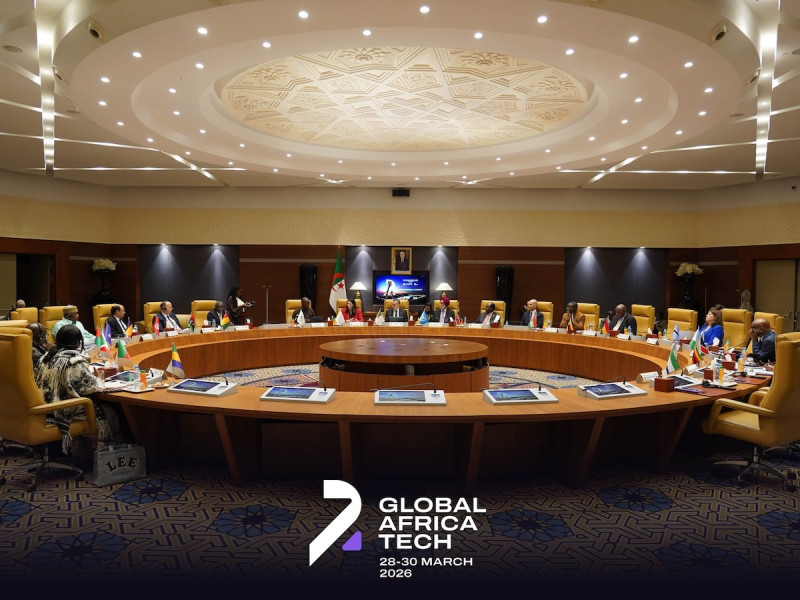
African ministers and partners have adopted a declaration agreeing to develop telecoms infrastructure as a strategic pan-African foundation for sovereignty, resilience, inclusion and economic transformation.
The Algiers Declaration on African Telecommunications Sovereignty and Integrated Connectivity (2026–2030) was adopted on Sunday in Algiers at the end of a ministerial summit during the first Global Africa Tech event, which wrapped up on Monday.
The declaration lays out a shared commitment to deliver meaningful and affordable connectivity for all, with priority to rural and underserved communities.
The declaration also calls for building integrated continental infrastructure that links terrestrial, subsea and satellite networks; strengthening local digital infrastructure such as data centres, internet exchange points and trusted cloud capabilities; and protecting critical telecoms infrastructure and enhancing resilience and cybersecurity.
Signatories also pledged to promote trusted, secure, and interoperable digital ecosystems, and invest in human capital and local industry to anchor long-term digital sovereignty.
William Kabogo Gitau, cabinet secretary for Kenya’s Ministry of Information, Communications and the Digital Economy (MICDE), said in a Facebook post on Sunday that the Algiers Declaration recognises that the digital divide is not only a development challenge, but a question of sovereignty and that inclusion and sovereignty must advance together.
“As a continent, we must now focus on implementation, coordination, and measurable progress ensuring that this shared vision translates into tangible outcomes for our citizens,” Gitau said. “Africa is moving with clarity and purpose towards a connected, resilient, and sovereign digital future.”
Five priorities for the work ahead
The Algeria Declaration builds on the African Union’s Digital Transformation Strategy (2020–2030), which calls for inclusive, secure, and scalable digital platforms as the foundation for long-term growth and for enabling digital transformation strategies adopted by governments across the continent.
Selma Malika Haddadi, deputy chairperson of the AU’s African Union Commission (AUC), said in a keynote address at Global Africa Tech on Saturday that while various countries across Africa have made individual progress in developing their own digital infrastructure and striking interconnectivity agreements, more needs to be done to unify those efforts for Africa as a whole to reach its full digital potential.
“No matter how interoperable our systems become, no matter how advanced our networks grow, no matter how many platforms, protocols and networks we develop, they will remain incomplete if they are not underpinned by a shared continental and political will,” Haddadi said. “We cannot build systems that connect Africans if we remain disconnected in vision. We cannot build a trusted continental infrastructure without also building trust in one another. We cannot speak of interoperability while tolerating fragmentation of purpose. Pan-Africanism reminds us that Africa rises most strongly when it acts in coherence.”
Haddadi illustrated the scope of the work ahead with statistics from the International Telecommunication Union (ITU) showing that mobile broadband covered 86% of Africa’s population at the end of 2024, yet 14% still had no way of connecting at all, especially in rural areas where that figure rose to 25%.
“Even more telling is the usage gap: millions live within network coverage, yet remain excluded by the cost of devices, the cost of data, limited digital skills, and low trust in digital systems,” she said. “This is not a marginal issue for the Africa we are building.”
Haddadi outlined five priorities that should guide work going forward: a resilient and diversified connectivity architecture across land, sea, and emerging space-based systems, closing the usage gap with affordable services and digital literacy, localisation of compute and data capacity, interoperability and reduction of regulatory fragmentation, and cross-border spectrum and technical coordination.
“The moving pieces are already in place,” she said. “What is now required is disciplined alignment, deliberate investment, and collective resolve.”
Source : www.developingtelecoms.com