MTN Ghana, Ghana Commercial Bank (GCB), and the Small and Medium-sized Enterprises Ghana Awards (SMEGA) have officially launched the SME Acceleration Programme, a joint initiative aimed at enhancing the capacity and growth of small and medium-sized enterprises (SMEs) in Ghana.
Unveiled in Accra on May 14, the programme seeks to promote business formalisation, increase market access, and strengthen resilience across key economic sectors. Running from May to November, the programme will provide targeted training in product packaging, customer service, branding, and value addition.
“We have over a hundred SMEs attending today’s edition,” said Mohammed Abubakari-Sidick, Senior Manager for SME at MTN Ghana. “They will be taken through the necessary training to foster development in their respective sectors.” He also noted that SMEs unable to attend in person can still benefit through the MTN SME Fair and Market Stall, offering them greater market exposure.
Emmanuel Brahuah, Partnership and Schemes Officer at GCB, highlighted the bank’s role in providing a robust package of financial support, including flexible loans, working capital, and tailored SME accounts. He emphasized GCB’s expanded focus on digital banking and financial literacy to ensure greater accessibility and efficiency for SME clients.
Kwesi Ofori Jnr., CEO of SMEGA, commended MTN for spearheading the initiative and affirmed SMEGA’s commitment to ensuring maximum SME participation across the country.
The SME Acceleration Programme represents a significant step forward in empowering Ghana’s SMEs—promoting sustainability, innovation, and economic inclusion.
Kampala, Uganda – Bayobab, the digital infrastructure arm of MTN Group, has launched a new 1,000+ km fiber optic route connecting Kenya and Uganda, with plans to expand into Tanzania. The deployment strengthens East Africa’s digital backbone, supporting hyperscalers, enterprises, and rural connectivity.
Key Highlights:
New Route: The 260 km Ugandan segment runs along the rail corridor (Kampala–Tororo–Malaba), linking major data centers in Kenya and Uganda.
Regional Expansion: Part of Bayobab’s “East-to-West Fibre” initiative, targeting 135,000 km of proprietary fiber across Africa by 2025.
Investment: The $13 million project enhances digital resilience and creates alternative data traffic routes.
Quote: “This isn’t just fiber—it’s a catalyst for East Africa’s digital transformation,” said Sylvia Anampiu, Bayobab Kenya MD.
The rollout aligns with MTN’s strategy to boost cloud services and attract tech investments in the region.
Source: Extensia.tech, with data from Agency EcoFin
The Global Africa Business Initiative (GABI) convened top public and private sector leaders at the Africa CEO Forum 2025 to fast-track Africa’s digital transformation. The high-level GABI Bridge side event was held under the theme “Connect. Empower. Prosper: The Big Push for Digital Africa.”
The session brought together decision-makers from government, finance, industry, and technology to explore how the continent can build inclusive digital infrastructure, nurture innovation ecosystems, and unlock new opportunities within the digital economy.
In her opening remarks, Sanda Ojiambo, Assistant Secretary-General and Executive Director of the United Nations Global Compact, emphasized the urgency of collective action:
“Africa’s digital future must be inclusive, sustainable, and African-led. This is not just a technological imperative – it’s an economic and social necessity.”
Highlights from the GABI Bridge Session:
Urgent Push for Infrastructure Investment: Stakeholders stressed the importance of coordinated public-private financing models to expand connectivity, especially in underserved rural areas.
Collaboration Across Sectors: Speakers underscored the role of strong public-private partnerships in enhancing regulatory frameworks and promoting sustainable digital transformation.
Empowering Local Innovation: The session called for enabling environments for startups through regulatory reforms, access to funding, and support for Africa’s homegrown tech talent.
Boosting Intra-African Trade via Digital Platforms: Harmonizing digital regulations is seen as key to unlocking the benefits of the African Continental Free Trade Area (AfCFTA), particularly in e-commerce and digital transactions.
Preparing Youth for the Digital Age: Educational systems must be modernized through curriculum upgrades, teacher training, and tech-industry collaboration to equip youth with future-ready skills.
The GABI Bridge concluded with a rallying call to turn ideas into action—transforming commitments into investment, partnerships into platforms, and ambition into measurable progress for Africa’s digital future.
Four suspects, one Nigerian and four Ghanaians have been arrested by the Ghana Police Service for allegedly shooting and killing a mobile money vendor in Aflao on April 28, 2025.
The arrest was made on May 10, 2025 between the hours of 1200 and 0200, by the Volta Regional Police Intelligence Department (RPID), in a joint intelligence-led operation with the Police SWAT Unit, Operation Motherland Taskforce, and ‘ACTION NOW’, a Community Watch Committee in Aflao.
These were contained in a press release published by the Ghana Police Service. According to the Service, the suspects are Michael Sewornu, aged 34, Korku Agboada, aged 43, Atsu Agbagla, aged 36 and Utsuku Onyeso, aged 22, a Nigerian. The 4 are currently in Police custody assisting in investigation.
The arrest comes almost 2 weeks from the day (April 28, 2025), when about five unidentified robbers attacked and shot Christopher Ahordo, a mobile money vendor, at Gbagblakope, near the Diamond Cement factory in Aflao, at around 6:30 pm. The deceased popularly known as Colombo, died at the scene, while the assailants took away his bag believed to contain money.
The Ghana Police Service used the press release to entreate the public to be security-conscious and collaborate with them by providing credible and timely information about criminals.
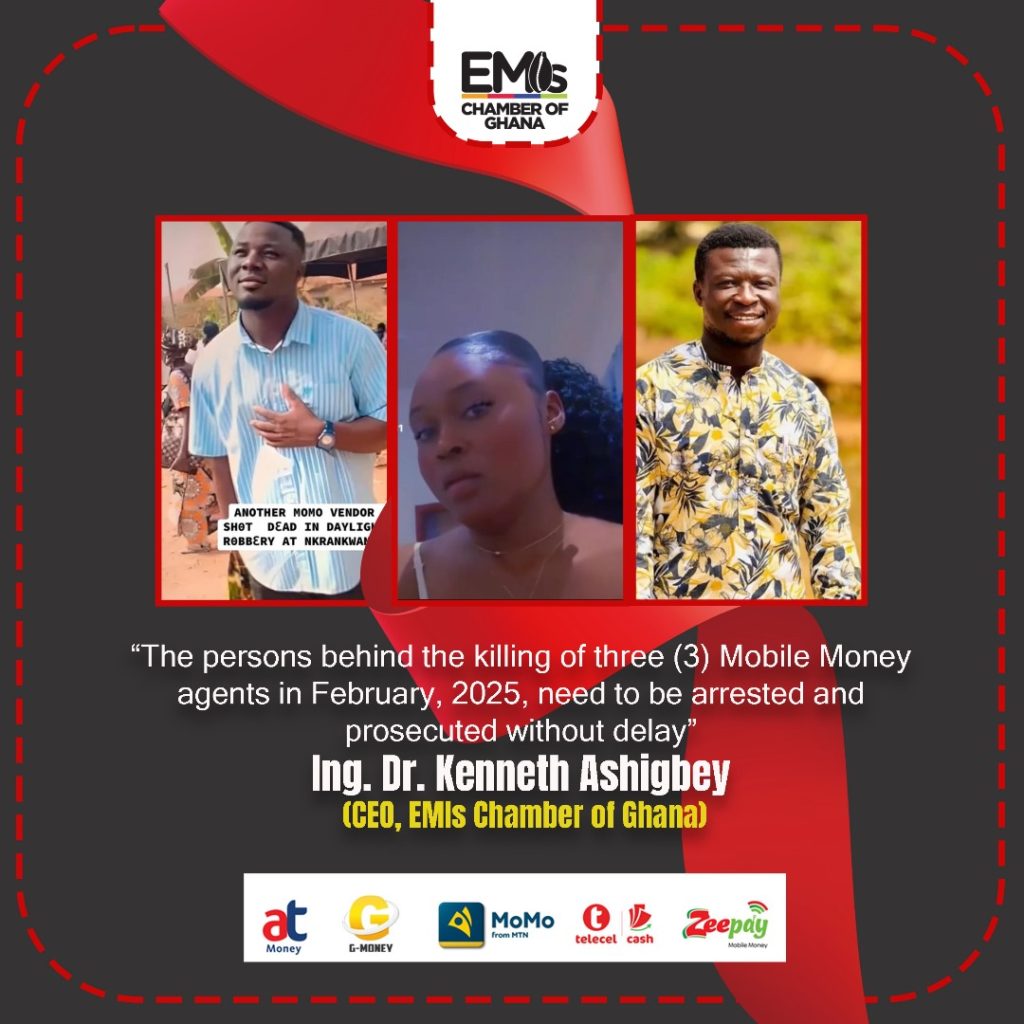
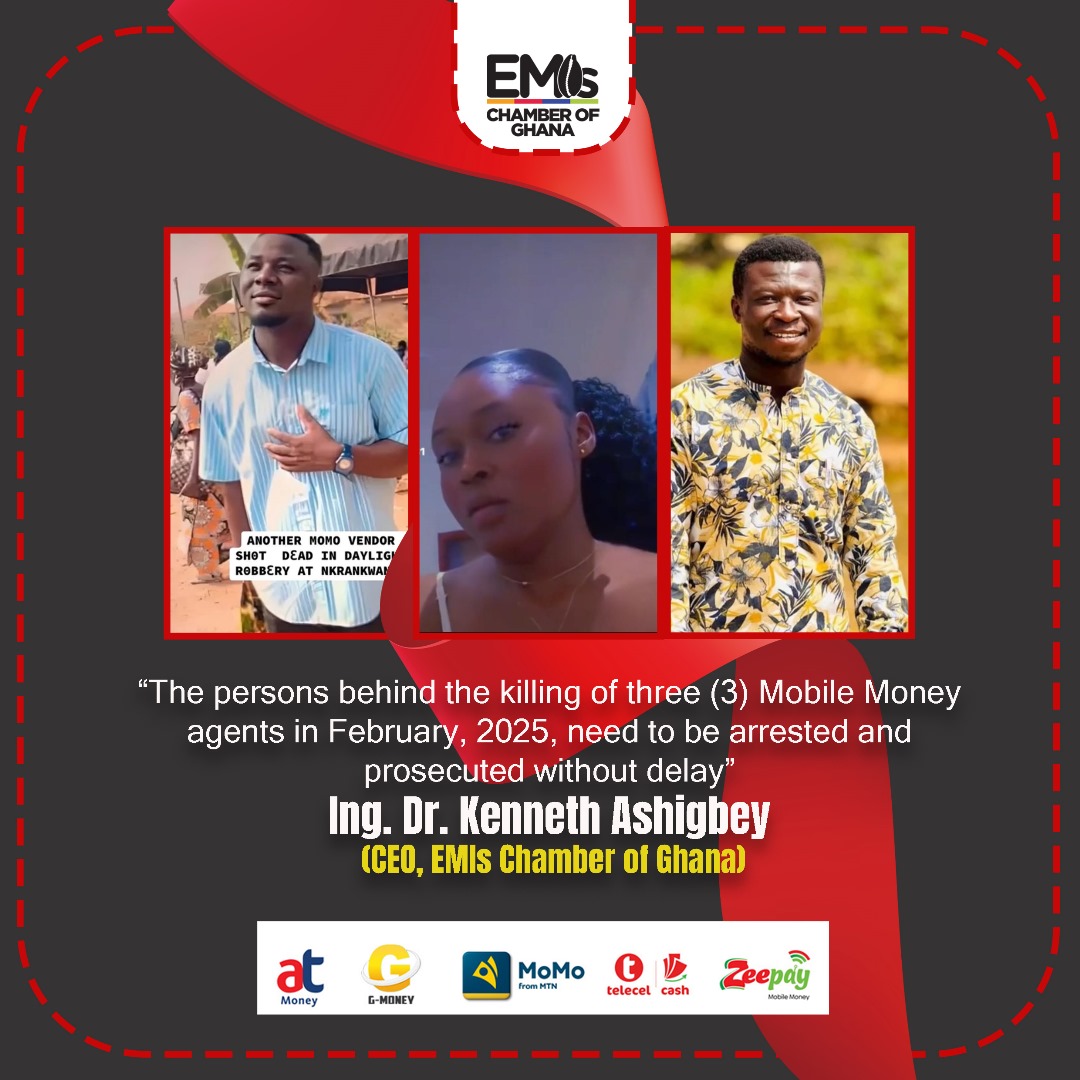
Let’s protect MoMo agents from senseless attacks – EMIs to Mahama, IGP, others
The Electronic Money Issuers (EMIs) Chamber of Ghana has strongly condemned the recent spate of violent attacks against mobile money agents, calling for urgent intervention to protect their lives and livelihoods. The Chamber extended its condolences to the families of agents who have been killed in these incidents, emphasizing that their role in Ghana’s financial ecosystem is invaluable and must be safeguarded.
Expressing deep concern over the escalating attacks, the Chamber has called on the President, the Interior and Finance Ministers, the Inspector General of Police (IGP), and the Governor of the Bank of Ghana to take immediate action. They urged law enforcement agencies to intensify efforts in apprehending the perpetrators and ensuring justice for the victims.
As part of its response, the EMIs Chamber is engaging with the leadership of the Ghana Police Service to explore effective security solutions. Additionally, discussions will be held with the Bank of Ghana to strengthen the Agent Registry and implement security measures to enhance the safety of mobile money agents.
The Chamber also debunked the misconception that mobile money agents carry large amounts of cash, warning that such misinformation makes them easy targets for criminals. They stressed that mobile money transactions are predominantly digital, with minimal cash handling.
To mitigate risks, the Chamber advised agents to adopt precautionary measures, including closing their shops early, avoiding carrying large sums of cash, installing CCTV cameras and alarm systems, and maintaining close contact with local police stations.
The Chamber reaffirmed its commitment to working with the government, security agencies, and stakeholders to address these security threats. It urged swift and decisive action to prevent further loss of life and ensure the safety of mobile money agents, who play a critical role in Ghana’s digital financial transformation.
Source: EMIs Chamber of Ghana Source of cover image: Ghana Police Service
Camtel, Cameroon’s national telecoms provider, has entered a five-year partnership with the Ministry of Public Health to enhance connectivity across the country’s healthcare system.
The agreement is set to strengthen Cameroon’s digital health strategy and support the rollout of its universal health care programme. Under the deal, Camtel will provide secure internet access, interconnect health sites, and deliver mobile and fixed telephony services alongside data security solutions.
Camtel will also play a key role in helping the ministry define its annual technical requirements, ensure remote supervision of services, and deploy effective monitoring tools.
In addition, Camtel will offer training to health workers to ensure full use of the digital resources and will maintain a focus on service quality.
“Camtel will continue to offer innovative solutions to state structures in a bid to support them in their digital transformation journeys,” said Judith Yah Sunday Achidi, General Manager of Camtel.
Mozambique has launched a rural connectivity pilot project to expand internet access to underserved areas, marking a significant move toward universal digital inclusion. Led by the Communications Regulatory Authority (INCM) in partnership with BDQ Mobile, Movitel, VANU, and Spacecom, the project is part of the government’s broader “Internet for All” program.
Minister of Communications and Digital Transformation, Américo Muchanga, hailed the initiative as “a giant leap forward” in guaranteeing every citizen’s right to communicate in the digital age. The pilot aims to deliver affordable, high-quality internet to remote communities, often overlooked due to lack of commercial viability.
Two base stations have been installed in Xinavane and Pessene in Maputo Province, each with a 50-kilometre coverage radius, potentially serving up to 15,000 people. The goal is to reach 95% network coverage, 99% service availability, and 80% mobile penetration by 2030, with targeted 5G speeds of up to 1 Gbps.
While only 6.45% of Mozambicans currently use the internet (per January 2025 DataReportal figures), the initiative also includes digital skills training to ensure effective adoption and access to services in education, health, governance, and economic development.
This pilot marks a crucial step toward closing Mozambique’s digital divide and achieving inclusive national connectivity.
Source: extensia.tech Original Source: Agency Ecofin
MTN Group President and CEO, Ralph Mupita, recently paid a courtesy visit to Hon. Paula Ingabire, Rwanda’s Minister of ICT and Innovation, during a working trip to Kigali. The visit included engagements with the leadership of MTN Rwandacell PLC and Mobile Money Rwanda.
Their discussions focused on developments in the ICT sector, particularly reflections on the AI Africa Summit held in Kigali in April 2025. The summit underscored the continent’s determination to play a leading role in the Fourth Industrial Revolution.
Mr. Mupita, who was recently appointed Deputy Chairperson of the GSMA (serving through 2026), reiterated MTN Group’s full support for MWC Africa 2025, also scheduled for Kigali. The event is a key platform uniting policymakers, operators, and innovators to drive inclusive and sustainable digital transformation across the continent.
MTN continues to champion Africa’s digital future through investments in connectivity, strategic partnerships, and leveraging AI-driven solutions to boost socio-economic development.
Source: extensia.tech Original Source: TechAfrica News
Accra, Ghana – Ghana recorded 5,600 incidents of fibre optic cable cuts in 2024, resulting in an estimated financial loss of US$9.2 million (over GH¢138 million) to the telecommunications industry, according to Dr. Kenneth Ashigbey, Chief Executive Officer of the Ghana Chamber of Telecommunications.
Dr. Ashigbey made the disclosure at the 24th edition of the Chamber’s Knowledge Forum, held in Accra under the theme “Leveraging Fibre for Accelerated Development.” The event was attended by key industry stakeholders, including the Director-General of the National Communications Authority (NCA) and representatives from various telecom operators.
A key highlight of the forum was the launch of the Telecommunications Industry Optic Fibre Minimum Specifications and Standards Manual, aimed at harmonising the deployment of fibre optic infrastructure nationwide.
In his address, Dr. Ashigbey underscored the far-reaching consequences of the rampant fibre cuts, noting that beyond the direct financial burden, the damage had severe implications for service delivery, business continuity, and public trust. He revealed that the cumulative time spent restoring these damages in 2024 exceeded 432 days.
“The average cost per fibre cut stood at approximately US$23,000, and in many instances, these cuts occurred repeatedly in the same locations, compounding the disruption,” he stated.
He stressed that the losses affected not only telecom companies but also small businesses, banks, emergency response services, and digital education delivery.
Causes of Fibre Cuts
Dr. Ashigbey identified road construction activities as the leading cause, responsible for 20.68% of all cuts. Other contributing factors included:
Theft and vandalism (13.98%), often due to the mistaken belief that fibre cables contain copper
Activities by private developers
Drain construction, farming, flooding, and fire
Accidental damage by other utility companies such as Ghana Water and the Electricity Company of Ghana (ECG)
He emphasized the vulnerability of Ghana’s digital backbone and called for a coordinated national response to protect it.
Call to Action
While acknowledging ongoing support from the NCA, Cyber Security Authority, and the Ministry of Communications, Digitalisation and Innovation, Dr. Ashigbey urged deeper collaboration with road agencies, utility service providers, and local assemblies.
He proposed several measures, including:
Mandatory relocation of telecom infrastructure in new road construction projects
Strict enforcement of excavation permit regulations
Creation of dedicated utility coordination units within infrastructure agencies
“We must treat telecom infrastructure as critical national infrastructure. Every dollar spent on repairing fibre cuts could be used to expand connectivity to underserved communities,” he added.
Dr. Ashigbey concluded by appealing to the Minister for Communications and Digitalisation to champion legislation consolidating existing frameworks to safeguard telecom infrastructure. He also called on the Ministers for the Interior and Attorney General to support enforcement efforts against those responsible for damaging the network.
Huawei Nigeria has inaugurated a state-of-the-art Innovation Centre in Lagos, aimed at accelerating Nigeria’s digital transformation and fostering local tech development. The launch was held during Huawei Day Nigeria 2025, a three-day event themed “Accelerating Industrial Intelligence.”
Key dignitaries in attendance included Dr. Bosun Tijani, Minister of Communications, Innovation, and Digital Economy; Dr. Obafemi Hamzat, Lagos State Deputy Governor representing Governor Babajide Sanwo-Olu; and several Huawei executives.
Chris Lu, CEO of Huawei Nigeria, described the new centre as a collaborative hub for customers, partners, and ICT talent to engage with cutting-edge technologies and co-create industry-specific solutions. “AI is not a technology of the future—it is now,” Lu remarked, positioning the centre as a driver of industrial intelligence and innovation in Nigeria.
Minister Tijani praised the initiative as a move towards Nigeria’s tech sovereignty, highlighting its potential to promote local co-creation over mere technology consumption. Deputy Governor Hamzat also commended Huawei’s role in enhancing data sovereignty through localized cloud solutions and strengthening the state’s ICT infrastructure.
Huawei, which has been present in Nigeria since 1999, reaffirmed its long-term commitment to advancing the nation’s digital ecosystem.
Source: Extensia.tech | Original reporting by IT Web
Helios Towers is capitalizing on the explosive demand for mobile data services across Africa and the Middle East, with a sharpened focus on improving its tenancy ratio and maximizing infrastructure utilization.
According to CEO Tom Greenwood, the company’s operations in nine high-growth markets—eight in Africa and one in the Middle East—are benefiting from mobile penetration rates that still lag behind Europe, offering significant room for expansion. While mobile phone usage in Europe averages 90%, it hovers around 50% across Africa. Subscriber growth is at about 5% annually, with data consumption projected to quadruple over the next five years in the region.
“Our business is driven by structural growth,” Greenwood explained. “As data usage increases, so does the need for mobile infrastructure.”
Helios currently operates 14,417 sites across Congo Brazzaville, DRC, Ghana, Madagascar, Malawi, Senegal, South Africa, Tanzania, and Oman. Its average tenancy ratio has increased to 2.09 tenants per site, and the company is on track to meet its 2.2x target by 2026. Revenue for Q1 2025 rose 5% to $203.8 million, with adjusted EBITDA up 9% to $111.1 million.
Greenwood emphasized that Helios is committed to organic growth, with no plans for new market entries or M&A at this time. “There’s so much demand where we are now, that’s keeping us busy.”
Helios forecasts 2,000–2,500 tenancy additions in 2025, with full-year adjusted EBITDA of $460–$470 million, and capex of $150–$180 million. The towerco is also backed by $5.3 billion in contracted revenues, 99% of which comes from multinational mobile network operators.
Source: Anne Morris, Contributing Editor, Light Reading – lightreading.com