Microsoft has launched a $1 million initiative to train one million Nigerians in artificial intelligence (AI) skills over the next two years, The Nation Newspaper has reported.
According to the report, the announcement was made by Microsoft’s Country Manager for Nigeria and Ghana, Ola Williams, during the launch of the Microsoft AI Tour in Lagos.
The initiative can potentially help to equip Nigerians with AI expertise, fostering digital transformation and workforce readiness in the country.
Nokia teamed with Japanese tech companies NTT and Anritsu to validate what they claimed is the world’s first proof of concept (PoC) for elastic networking, a technology designed to enhance energy efficiency in mobile networks.
Developed under trade body Innovative Optical and Wireless Network (IOWN) Global Forum, elastic networking reallocates network resources on demand. The technology allows operators to switch off radio and optical equipment when traffic is low and redirect network resources when demand is high. This “intelligent” resource allocation apparently does not compromise network performance even in densely populated urban areas.
Nokia touted the technology will help operators in Japan, including NTT, meet rising AI-driven bandwidth demands while reducing energy consumption.
In a statement, the vendor stated the PoC utilised Nokia’s high-performance optical solutions to demonstrate real-world energy savings.
James Watt, VP and GM Optical Networks Division at Nokia, affirmed that reducing energy consumption across the vendor’s product portfolio was a priority. “This successful PoC highlights the trusted performance and resilience of our optical products,” he stated, adding that the vendor plans to continue collaborating with industry players including IOWN to develop energy-optimised wireless networks.
The move aligns with Nokia’s previous energy-saving efforts, such as enhancing its energy efficiency software in 2023 with advanced algorithms and power-saving features, enabling operators to reduce network power consumption by up to 30 per cent.
Apple took the wraps off of its low-end iPhone 16e priced at $599 as it attempts to revive sluggish growth by including advanced AI tools.
Apple is attempting to better compete against AI-enabled devices from Google and Samsung, but at a lower price point than its high-end iPhone 16 models.
The iPhone 16e lays to rest the iPhone SE first introduced in 2016 and updated three years ago. Bloomberg reported it will cost $170 more than an SE due to advanced features such as the same A18 Pro chip used in the iPhone 16 devices announced in September.
The A18 chip is built with second-generation 3nm transistors and is 20 per cent faster than the A17 chip used in previous phones.
It is also the first iPhone to use the C1 chipset developed internally by Apple.
The iPhone 16e has enough compute power to run Apple Intelligence, the software set of AI tools that includes access to OpenAI’s ChatGPT.
It features a 6.1-inch OLED display, a single 48MP rear camera and a 12MP front-facing camera.
Kaiann Drance, VP of worldwide iPhone product marketing, stated the 16e is optimised for longer battery life. It lasts up to six hours longer than an iPhone 11 and up to 12 hours longer than all generations of iPhone SE.
It comes equipped with the same Action button as the iPhone 15 Pro and iPhone 16 lines. The Action button allow users to access a variety of functions.
It is available in two colours, black and white, and is available for pre-ordering on 21 February with shipping slated for 28 February.
The new smartphone does not include support for MagSafe cases, wallets and wireless chargers. It does have wireless charging capabilities up to 7.5W.
It does not have support for ultra-wideband technology but does include satellite-based texting to friends and family and support for SOS messaging.
Analyst Paolo Pescatore said the new model “should help accelerate adoption and especially its foray into AI with Apple Intelligence”.
“Apple’s trust and credibility is critical. This alone will help drive sales and lure users from rival devices and platforms,” he said.
As part of its lineup shift, the iPhone SE and iPhone 14 are no longer available.
Apple’s smartphone revenue in fiscal Q1 2025 (the period to 28 December 2024) was $69.1 billion, flat year-on-year. Sales in China fell by 11.1 per cent to $18.5 billion.
Maroc Telecom’s capital expenditures in its sub-Saharan African subsidiaries operating under the Moov Africa brand reached MAD7.96 billion ($800.1 million) in 2024, according to the company’s annual financial report for the year published on Friday, February 14. This figure represents a growth rate of 75% compared to the MAD4.54 billion invested by the company in 2023.
The company did not detail the precise allocation of the funds invested, but it indicates that 3.54 billion dirhams were devoted to the purchase of frequencies and licenses. “The evolution of the amount of licenses is mainly explained by the renewal of Mobile licenses at Sotelma [Mali, Editor’s note] and Moov Africa Chad,” the company declared. In Mali, for example, the operator paid 160 billion CFA francs ($256.2 million) to renew its telecoms license.
This comes amid growing momentum in Maroc Telecom’s investments in its sub-Saharan African subsidiaries. In 2022, the company invested 4.5 billion dirhams, compared to 2.98 billion dirhams in 2021. The company even invested 150 million euros ($157.2 million) in the construction of a new 9,414 km long submarine fiber optic cable to serve its Moov Africa subsidiaries.
Subsidiaries in Sub-Saharan Africa are gradually becoming the group’s main growth driver. At the end of 2024, Moov Africa recorded a turnover of 18.7 billion dirhams, up 4.6%, driven by the growth of Mobile Data (+15.6%), Fixed Internet (+21.1%) and Mobile Money (+14.4%). Meanwhile, turnover in Morocco fell by 2%, to 19.1 billion dirhams. A trend that is confirmed after 2023, where revenues in Sub-Saharan Africa had increased by 6.6%, while those in Morocco had remained stable.
Maroc Telecom is facing increased competition in a saturated domestic Moroccan market, where players such as Orange and Ooredoo are exerting strong pressure. Conversely, in sub-Saharan Africa, the growth potential remains significant: in 2023, only 44% of the population estimated at 1.2 billion by the World Bank had access to mobile services and 27% to mobile Internet, according to the Global Association of Mobile Phone Operators (GSMA). The rise of mobile money also accompanies this dynamic, in a region where a large part of the population remains unbanked. The region had 234 million active mobile money accounts in 2023, according to the GSMA.
Despite sub-Saharan Africa’s potential, Maroc Telecom faces increasing competition from players such as Airtel Africa, Orange, Airtel Africa and MTN Group. The latter has around 230 million subscribers across all its markets in the region, including Benin and Côte d’Ivoire, which it shares with Maroc Telecom. In Côte d’Ivoire, for example, Moov Africa held a market share of 19.6% as of June 30, 2024, compared to 27.8% for MTN and 52.6% for Orange, according to the Telecommunications Regulatory Authority (ARTCI). In Benin, Moov had a market share of 33.45%, behind MTN (49.06%), but ahead of Celtiis (17.49%), according to official statistics.
Ahead of MWC25 Barcelona, GSMA Intelligence has launched research highlighting a dramatic shift in the global economy, with advanced connectivity and mobile technologies to contribute $11 trillion to global GDP by 2030 – which represents 8.4% of the total. This surge represents a significant increase from the contribution of $6.5 trillion (5.8% of overall GDP) in 2024, emphasising the growing role and exciting potential of digital technologies and enterprise transformation in reshaping industries.
GSMA Intelligence’s Economic Growth and the Digital Transformation of Enterprises 2025 report highlights manufacturing, financial services, automotive and aviation as pivotal sectors, contributing nearly 34% of the projected $11 trillion impact by 2030. Advanced connectivity will continue to transform these industries, driving significant cost efficiencies and revenue growth globally.
Advanced connectivity such as 5G is unlocking new opportunities for innovation and growth. However, to realise its full potential, more collaboration is needed between policymakers, network operators and enterprises to overcome barriers to enterprise adoption such as high implementation costs and lack of technical expertise. Only through deep cooperation can we fully harness the benefits of this digital revolution.
– Pau Castells, Head of Economic Analysis, GSMA Intelligence
Manufacturing
Manufacturing currently accounts for 23% of global GDP, facing significant challenges including supply chain disruptions and the need to adjust to climate targets. Promisingly, the adoption of technologies such as IoT, robotics and big data analytics is projected to boost the sector’s GDP by $2.1 trillion by 2030.
By integrating advanced connectivity solutions, including 5G, the report predicts manufacturers could achieve over $400 billion in annual cost savings by 2030.
Financial services
The financial services sector currently contributes 7% to global GDP, experiencing rapid transformation through widespread adoption of technologies including cloud computing, AI, and blockchain. According to our research, this transformation will boost the sector’s GDP by nearly $900 billion by 2030.
Next-gen connectivity plays a central role in enabling new channels to real-time data analysis, integration of artificial intelligence for improved task efficiency and faster time to market for new products. By 2030, this could uplift sector’s revenue by nearly $140 billion in indirect benefits.
Automotive
The automotive sector contributes approximately 3% to global GDP, and it is undergoing a profound transformation driven by the adoption of connected, electric and autonomous mobility solutions. By 2030, digital technologies are expected to increase the industry’s GDP by almost $600 billion.
5G will play a critical role in enabling smart automotive factories and autonomous vehicle operations, saving the sector a projected $45 billion annually by 2030.
Aviation
Contributing 1% to global GDP, the aviation sector uses digital technologies to enhance operational efficiency and passenger experiences. Digital transformation is expected to boost the sector’s GDP by $200 billion by 2030.
5G-enabled smart airport solutions, including IoT sensors and AI-powered systems, will enhance infrastructure monitoring, asset tracking and security systems, potentially saving airports $10 billion annually by 2030.
Redefining connectivity with 5G
As industries worldwide undergo rapid digital transformation, 5G stands out as a key component of economic growth, with nearly 85% of enterprises rating 5G as critical to their digital transformation strategies. With ultra-fast data transmission, low latency and massive device connectivity, 5G is enabling use cases previously constrained by legacy technologies. The report highlights that industries adopting 5G technologies are experiencing accelerated progress in automation, AI integration and IoT-based solutions.
Supporting Digital Transformation with GSMA Connected Industries at MWC
GSMA Connected Industries returns to MWC25 Barcelona this year to showcase the transformative potential of advanced mobile technologies and diverse solutions across Manufacturing and Production, Fintech and Mobile Commerce, Smart Mobility and Sports and Entertainment. Bringing together a wide range of businesses and industry leaders, Connected Industries is an exclusive showcase of how 5G, IoT and other digital solutions are powering smarter and greener operations, unlocking new possibilities in advanced connectivity and accelerating the next wave of industry 4.0.
Connected Industries at MWC offers a unique opportunity for businesses and technology leaders to hear first-hand from our GSMA members and partners on how emerging mobile technologies and 5G applications are shaping industries and enabling new use cases like enhanced factory floor automation, improved fraud prevention, smart airports and connected and autonomous vehicles. Mobile is certainly at the heart of digital transformation and our summits at MWC will showcase these innovations throughout the week.
– Richard Cockle, Connected Industries lead and Head, GSMA Foundry
The GSMA also supports Connected Communities, an initiative to bring mobile network operators and industry together to innovate. Members can get involved in the communities to collaborate on technical projects, participate in thought-leadership, share knowledge and insights, network with the broader ecosystem and help to drive digital change. The GSMA’s Connected Communities span Connected Manufacturing and Production, Connected Fintech and Mobile Commerce, Aviation, 5G IoT, 5G Futures, Identity and Data, the Tower & Fibre Forum, Non-Terrestrial Networks (NTN) and Satellite and the 5G Innovation and Investment Group Forum.
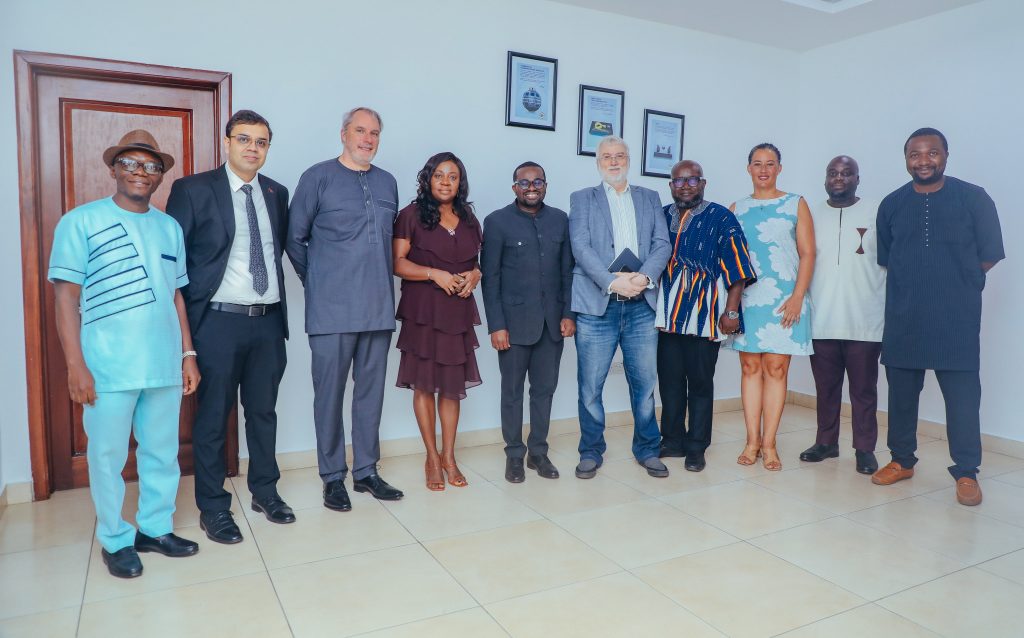
The newly appointed Director-General of the National Communications Authority (NCA) Rev. Ing. Edmund Yirenkyi Fianko, has assured the Ghana Chamber of Telecommunications of enhanced collaboration to drive industry growth. In a meeting with the Chamber’s leadership, the NCA boss emphasized strengthening regulatory engagement, improving policy implementation, and fostering a more cooperative relationship with telecommunications industry.
According to him, growth in Ghana’s telecommunications industry can be achieved if all stakeholders including regulators, policy makers, companies and customers, collaborate effectively.
The leadership of the Chamber welcomed the commitment, expressing optimism about greater industry-government synergy to address sector challenges and enhance digital transformation efforts.
He made the remarks during a courtesy call on him and his leadership team at the NCA Tower in Accra on Wednesday February 19th, 2025, by a high-powered delegation from the Ghana Chamber of Telecommunications, led by its Chairperson and CEO of Telecel Ghana, Ing. Patricia Obo-Nai.
Key Matters Discussed
The meeting, between the two teams, focused on strengthening collaboration with the NCA to support the Authority in achieving its goals. Other issued discussed include the following;
Protection of telecommunications infrastructure across the country
Ending the incessant destruction of fiber optic cables
Review of the cost of power to industry members
Review of the numerous taxes and fees affecting the growth of the industry
Collaboration to enhance advocacy on key matters
Honoring payment obligations to support the NCA
Stakeholder collaboration to address growth-hindering constraints for Ghana’s telecommunication industry and the digital ecosystem as a whole
The leadership of the Chamber, went on to present a copy of its Telecommunications Industry Optic Fibre Minimum Specifications and Standards Manual which sets out the minimum industry specification and standards for the deployment of fibre optic cables in Ghana. The self-regulatory document was developed by benchmarking industry standards from Europe, Egypt and countries with successful fibre deployment systems and the experience of the Ghanaian operators.
On his part Rev. Ing. Edmund Yirenkyi Fianko, assured the Chamber that the standards will be considered and added to the list of standards the NCA will be sharing with the Ghana Standards Authority, to be adopted as Ghana’s standards for this year.
Ongoing Collaboration and Next Steps
All parties agreed to structure regular engagements and maintain open channels for technical discussions and collaborative work that will inure to the benefit of the final consumer.
Visa, a digital payments business, has produced a new research outlining digital payment development potential, particularly among Kenya’s small and medium-sized enterprises (SMEs).
According to the report, 40% of SMEs have used digital payments within the last two years.
This impetus, according to Visa, is driven by the awareness that investments in payment technologies, such as card payments, mobile and digital wallets, are critical for business growth.
Convenience (40%), cost savings (38%), and greater efficiency (37%) are the top reasons given by SMEs for embracing digital payments.
“Kenya’s digital payments landscape is experiencing a dynamic growth, fuelled by a rising preference for innovative payment methods and value-added services that provide enhanced security and streamline operations” Chad Pollock, VP and General Manager, Visa East Africa said..
“This shift presents a significant opportunity to boost both individual prosperity and broader economic development,” he said.
While cash comfort remains a hurdle, the survey finds that almost all digitally equipped SMEs (97%) continue to be concerned about cash security.
This makes a compelling case for pushing digital payments as a more secure and economical alternative.
Furthermore, there is a strong need for improved security measures among organisations that already accept digital payments, with 71% indicating a need for secure B2B payment solutions and 69% requesting advice on payment security best practices.
Given these dangers, the research suggests that promoting secure digital payment solutions is a potential strategy for SMEs seeking to reduce security risks.
‘’Promoting secure digital payment options as a fundamentally safer way to conduct business can help mitigate these risks, fostering trust and further prompting a shift away from cash.’’ the report notes.
Visa’s ‘Value of Acceptance: Understanding the Digital Payment Landscape in Kenya’ analysis, conducted by 4Sight Research & Analytics, investigates the present state of digital payment acceptance, identifying both potential and problems.
The findings are based on face-to-face interviews with 254 SME owners/managers who make critical business choices on a daily basis.
Australia-based operator Telstra signed-up with Ericsson to deploy what the pair claimed as the first programmable network in the Asia Pacific region, citing benefits around the provision of bespoke capabilities to customers.
The four-year project will see the operator’s radio network upgraded to Ericsson’s latest open RAN-ready hardware and deployment of 5G-Advanced software.
AI and automation technology is set to be used to optimise network management, through self-detection of problems and self-healing.
Ericsson noted the new infrastructure would provide a platform for development of new applications and give the operator the ability to tailor connectivity based on customer need.
Highlighting the fact it and Telstra were founding members of API focused company Aduna, Ericsson explained the new kit would provide the means to “open the network to tech innovators from wider ecosystems via network APIs”.
Telstra CEO Vicki Brady said: “We are at an inflection point, where customer needs for technology and connectivity are becoming more sophisticated, requiring a step change in how connectivity is delivered and consumed. At the same time, demand for mobile data on our network has tripled over the past five years.”
The executive added its new network infrastructure would “evolve our offering and improve the efficiency of how we use our spectrum so we can increase our 5G network capacity to deliver better consistency of performance, reliability and speed to millions of customers”.
Nearly all telcos are assessing or deploying AI, according to NVIDIA’s State of AI in Telecommunications survey.
More than three-quarters of respondents already seeing return on investment through cost savings and/or increased revenue.
37% of operators focusing investment on applying AI or GenAI in network planning and operations, including integration in radio access networks.
Findings appear to bode well for nascent AI-RAN developments.
NVIDIA: AI delivering ROI for telcos, advancing into production
Source: NVIDIA
Telcos are seeing increasing cost savings and revenue boosts from investments in artificial intelligence (AI) and showing greater willingness to take the technology deeper into their networks, according to new research from NVIDIA, which TelcoTitans discussed with the vendor’s Global Head of Business Development for Telco, Chris Penrose.
The third annual State of AI in Telecommunications report takes the pulse of telcos’ plans and experiences with the technology and the results look encouraging for its author, AI system and software behemoth NVIDIA — with headline finding being that nearly all (97%) telecom operator respondents are assessing or adopting AI.
The technology is already considered to be delivering results for most, as 83% of operators said AI is helping to increase revenues, up from 72% in last year’s survey. Some (21%) have seen AI contribute revenue uplift of more than 10%, while 38% have tracked increases of less than 5%.
AI is also helping operators to reduce costs, with 77% agreeing that the tech has supported decreases in annual operating costs.
“ More than three quarters of companies indicated that they are seeing a positive impact on return on investment [ROI]… [they] are seeing real dollars begin to happen” –Penrose.
Chris Penrose
Source: NVIDIA
Part of the higher ROI realisation is driven by AI projects progressing from proof of concepts to “full production”. As solutions scale out, “that’s really where the big ROI is going to come”, Penrose said.
Telcos are seeing the biggest impacts from AI in higher employee productivity, enhanced customer experience, and improved network operations, the survey found.
AI buds in the network
Improving customers experience remains the top AI use case and investment area for telcos, according to the survey.
The next highest-ranked use cases were network planning and operations (which includes integrating AI into RAN infrastructure) and optimising field operations.
“ The network side has really evolved, with now 37% saying that they’re applying AI and generative AI in the network space, particularly network operations. This is the core of what they do… [They can] apply [AI] in the network itself to drive better performance that could be everything from energy savings to spectral efficiency” – Penrose.
Along with the opportunity to improve how the network performs, Penrose said telcos can have, “for the first time”, a common set of infrastructure that can support the radio access network (RAN) as well as other AI workloads.
“ We’re seeing a lot of interest around this because telcos spend so much capital on proprietary networks today but they’re massively underutilized. They’re designed for the peak hour, but at midnight, you’ve got a lot of spare capacity. We can redeploy those compute assets to do AI and GenAI. It’s a whole new opportunity to create revenue. ” – Penrose.
NVIDIA is one of the founding members of the AI-RAN Alliance, which launched at February 2024’s Mobile World Congress (MWC), along with Amazon Web Services, Arm, DeepSig, Ericsson, Microsoft, Nokia, Northeastern University, Samsung Electronics, SoftBank, and T-Mobile US (Deutsche Telekomwatch, #133). The organisation has since increased to 50 members, including telcos Boost Mobile Network, Globe Telecom, Korea Telecom, and SK Telecom. Demonstrations of the Alliance’s work are expected to be on show at Arm’s stand at MWC 2025. The group’s aim is to: use AI to improve RAN spectral efficiency; integrate AI and RAN to use infrastructure more efficiently and open revenue opportunities; and deploy AI services at the network edge through the RAN. SoftBank is possibly the most advanced operator in exploring AI-RAN’s potential.
This year’s survey included a section dedicated to telcos’ plans for, and adoption of, GenAI, finding that the sector is one of the fastest to implement the technology, according to Penrose.
But the “shocking” result for Penrose was that 84% of respondents said they intend to offer GenAI services to their customers. “That’s a really powerful statistic”, he said.
To enable these services, NVIDIA is seeing interest in Europe and Asia for “sovereign AI”, whereby telcos are supporting governments in establishing national AI infrastructure, said Penrose.
NVIDIA has partnered with 14 telcos on sovereign AI solutions, including Iliad Group subsidiary Scaleway, Swisscom and its Italian subsidiary Fastweb, and Telenor.
The national infrastructure can offer anything from AI training and inferencing as a service to GPU-as-a-service for startups and businesses, he explained.
“ This really does provide a new opportunity to drive revenue now but also use the same infrastructure to drive their own cost savings and support the network for the future. And when all those things come together, it becomes a very exciting place for the telcos to lean into. ” – Penrose.
Recent examples of telcos bundling GenAI into their consumer services include Telefónica and Deutsche Telekom offering Perplexity’s digital search assistant. Both operators are also investors in the GenAI scaleup via their respective corporate venture arms, along with NVIDIA. Meanwhile, Orange Business launched a suite of GenAI services for enterprises earlier this year under its Live Intelligence product range. French rivals Iliad and Bouygues offer twelve months free access to AI digital assistants from Mistral AI and Perplexity, respectively. In the UK, EE’s 5G standalone network launch in September last year was pitched as part of the operator’s efforts to prepare for an expected influx of AI-powered devices.
Finding AI talent remains top challenge
The survey also found some persistent challenges to telco adoption of AI, with the top three obstacles the same as in the 2024 survey.
The biggest hurdle to scaling AI is lack of talent, such as finding data scientists, engineers, architects, and developers.
More respondents this year (38%) pointed to ’inability to quantify ROI’ as an issue, up from 33% last year, while 30% cited lack of budget for AI as problematic.
Key findings from NVIDIA’s State of AI in Telecommunications survey
84% — AI is helping to increase their company’s annual revenue.
77% — AI helped reduce annual operating costs.
97% — Either actively deploying or assessing AI projects.
60% — Increased employee productivity the biggest benefit from AI.
44% — Investing in AI for customer experience optimisation, which is the top area of investment for AI in telecommunications.
40% — Deploying AI into their network planning and operations, including RAN.
49% — Adopted GenAI solutions.
84% — Using GenAI plan to offer solutions to the customer.
From the U.S. to Saudi Arabia, people are leveraging digital wallets due to their fast and efficient way to send and receive money internationally. This shift in payment preferences speaks to the demand for convenience and simplicity, the report notes, especially when compared to traditional methods like bank transfers or money transfer services.
Among the countries surveyed — Saudi Arabia, Singapore, the U.K. and the U.S. — digital wallets emerged as the leading option for cross-border payments. On average, the report shows 42% of consumers across these countries preferred digital wallets for their international transactions.
US Leads in Digital Wallet Adoption
The U.S. stands out with 44% of consumers choosing digital wallets over other payment methods, the report notes, far ahead of other options like bank accounts and money transfer services. Consumers are more likely to send money to family or friends, a common type of cross-border payment. Nearly 75% of U.S. consumers who made cross-border payments in the past year sent money to their loved ones. These transactions are often remittances, underscoring how important digital wallets have become in the process of sending small, frequent payments across borders.
Singapore: A Tradition of Bank Transfers
In contrast, Singapore shows a different trend. Only 27% of Singaporean consumers prefer using digital wallets for cross-border transactions, with 37% still relying on bank accounts. This reliance on traditional banking services may stem from Singapore’s advanced financial infrastructure, where people have been accustomed to using bank accounts for payments. While the use of digital wallets is gaining traction, it has not yet surpassed the comfort and familiarity of bank accounts, which remain a preferred method for many Singaporeans.
Saudi Arabia: A Blend of Digital and Traditional Payments
Meanwhile, Saudi Arabia provides an interesting case with a blend of digital and traditional methods. Like other countries, remittances sent to family and friends are common, but payments from employers and gig platforms are also significant. In Saudi Arabia, the report shows, digital wallets are highly favored for sending and receiving payments as well, though the shift has been slower compared to other regions. But the country’s reliance on traditional banking methods for certain payment types has slowed the overall adoption of digital wallets.
Speed and Convenience Drive Digital Wallet Adoption
One reason digital wallets are preferred for cross-border transactions is their speed and convenience, according to the report. Digital wallets provide an efficient way to move money without the delays that often accompany bank transfers or money transfer services. This speed is particularly valuable for consumers who send small-value payments regularly, such as remittances to family members. The ease of linking a digital wallet to a mobile device means sending money across borders is as simple as a few taps on a screen, removing much of the complexity that accompanies traditional methods.
Another factor contributing to the preference for digital wallets is the ability to send money to recipients who use the same wallet. Many consumers who use digital wallets for cross-border payments report that they typically send money to people who also use the same service. This creates a streamlined, seamless experience that avoids the friction associated with using multiple payment systems.
In countries like the U.S., U.K. and Saudi Arabia, nearly two-thirds of digital wallet users said they typically send funds to recipients who use the same mobile wallet. This level of compatibility is an advantage over traditional methods, which often require coordination between different banks or services to facilitate the transfer.
Overcoming Interoperability Challenges
While the trend toward digital wallets is evident in several regions, challenges remain, according to the report. Interoperability, or the ability for different wallet systems to work together smoothly, continues to hinder the growth of cross-border transactions. Even in markets where digital wallets are popular, consumers may still face challenges when sending money to different countries or dealing with different currencies. These issues highlight the need for further integration and innovation within the digital wallet ecosystem to make global money movement easier and more efficient for all users.
Preferences for cross-border payment methods vary by region, but digital wallets are clearly becoming a key tool for international transactions. Their ease of use, speed and capacity to manage frequent, small-value payments make them an appealing option for many consumers. As interoperability improves and the digital wallet infrastructure expands, more consumers around the world are likely to rely on them for cross-border payments.