The Minister for Communication, Technology, and Innovation, Sam George, has disclosed plans for the consideration of a framework that would allow mutual recognition of fintech and payment service licences between Ghana and Zambia to ease cross-border business operations.
He explained that the current system forces companies already licensed under one regulatory regime to repeat the entire approval process when entering another market, despite operating under similar standards.
Speaking on the Citi Breakfast Show on Monday, April 20, Mr George said this creates unnecessary bureaucratic bottlenecks that slow down private sector expansion and cross-border innovation.
“The Bank of Zambia fintech policy was modelled and structured with technical expertise from the Bank of Ghana. So, if a company in Zambia, using those benchmarks that have been created, goes through the rigorous process of getting a PSP licence, must that company come to Ghana and start afresh from the beginning again? he questioned.
According to him, the goal is to allow companies that have successfully obtained licences in either Ghana or Zambia to operate across both jurisdictions without restarting the entire licensing process.
Mr George stressed that the proposed alignment would significantly improve the ease of doing business, reduce administrative delays, and strengthen fintech collaboration between the two countries.
The Vice-President, Professor Naana Jane Opoku-Agyemang, has urged Ghanaians to uphold responsible digital conduct as the irresponsible use of digital platforms threatens national peace and cohesion.
She has also raised concerns about the growing misuse of social media and online platforms, particularly the spread of misinformation, disinformation and hate speech.
She has, therefore, called on stakeholders to be accountable for their words and actions online, stressing that “any action that tears away the peace in this country is not something we should encourage.”
Visit
Vice-President Opoku-Agyemang expressed these concerns during an engagement with management and staff of the Ministry of Communication, Digital Technology and Innovations.
The engagement formed part of her ongoing working visits to ministries and agencies as part of efforts by her office to strengthen coordination across ministries, departments and agencies (MDAs).
Prof. Opoku-Agyemang was accompanied by the Chief of Staff in the Office of the Vice-President, Alex Percival Segbefia, and other senior officials of the office.
She was received by the Minister for Communication, Digital Technology and Innovations, Samuel Nartey George, together with management, staff, and heads of the agencies under the ministry.
Home-grown solutions
Prof. Opoku-Agyemang encouraged innovation and advised against over-reliance on foreign digital platforms
She acknowledged the benefits of aligning with global digital systems. However, she challenged the ministry and its agencies to begin laying the groundwork for home-grown digital solutions, even if their full realisation would take decades.
“We must ask ourselves, what are we doing now to ensure that we build our own?” she said.
Planning
The Vice-President also highlighted the importance of long-term planning in the country’s digital and technological development.
She urged institutions to think beyond immediate outcomes and define a clear national trajectory for Ghana’s digital and technological future development.
“Where should Ghana be in 10 years, and what are we doing now to ensure we are ahead?” she asked.
Prof. Opoku-Agyemang commended the minister and his team for their efforts and assured them of the government’s continued support.
She welcomed ongoing legislative reviews within the sector, describing them as necessary to keep pace with emerging developments in digital space, including artificial intelligence.
She described them as critical to national progress, and pledged support when the reforms are presented for consideration.
The Vice-President also praised ongoing initiatives such as the Ghana Books project, acknowledging the contributions of female professionals in the sector, and commended Ghanaian experts for their role in advancing artificial intelligence and digital innovation.
She emphasised the need to protect Ghana’s intellectual property while expanding the reach of local innovations.
The Vice-President also welcomed efforts towards a paperless administration, describing digitalisation as both an environmental and efficiency-driven necessity benefits.
“As we go digital, we must also protect our data. When your data gets wiped out, it’s not a very beautiful story,” she added.
Efforts
Mr George outlined reforms in the sector aimed at repositioning the country’s digital ecosystem as part of President John Dramani Mahama’s reset agenda.
He said the reforms were underpinned by a comprehensive review of the legislative framework governing the sector, saying existing laws were obsolete, with some dating back to more than two decades and were no longer fit for purpose.
The Communication Minister revealed that work was underway on 15 new legislations, including the reviews of the Electronic Communications Act, the Electronic Transactions Act, Cybersecurity legislation, data protection laws and the legal framework governing the National Communications Authority (NCA) and the Ghana Investment Fund for Electronic Communications (GIFEC).
Mr George said all the reviews would be presented to Cabinet following extensive stakeholder consultations involving the ministry’s 11 agencies.
A key legislative priority, he said, was a proposed Misinformation, Disinformation and Hate Speech Bill, designed to address emerging threats from artificial intelligence, deepfakes and digital manipulation, while safeguarding constitutional freedoms.
The minister also highlighted President Mahama’s flagship One Million Coders Programme, describing it as the cornerstone of the country’s digital future.
He disclosed that despite funding constraints, the ministry had secured 20,000 custom-built laptops and was set to roll out training in 100 constituencies by the end of the first quarter of the year
(A milestone decision to accelerate Ghana’s digital transformation and reduce fibre cuts nationwide)
Ghana’s Cabinet has approved a transformative proposal from the Ghana Chamber of Telecommunications to integrate fibre-optic ducts and access chambers into all new road construction projects across the country.
The announcement was made by the Minister for Communications, Digital Technology and Innovations, during a high-level discussion at the Africa Tech Festival in Cape Town, South Africa. The move positions Ghana as a continental leader in infrastructure-led digitalisation and sets a precedent for other African nations to follow.
“What Ghana’s Cabinet has approved is this, every new road is also going to be a digital new road,” the Minister stated. “Contractors will now build fibre chambers alongside roads, effectively eliminating the capital cost of digging for telecom operators. This will make network rollout faster, cheaper, and more sustainable, thereby allowing operators to reinvest in expanding connectivity.”
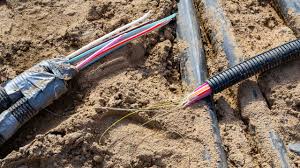
The policy, often referred to as the “Dig Once Policy”, stems from sustained advocacy by the Ghana Chamber of Telecommunications and its member companies. The Chamber’s technical justification highlighted that about 60% of fibre cuts in Ghana, a major cause of service interruptions, are caused by road and construction activities. Between 2021 and the first three (3) quarters of 2025, fibre repair costs is projected to be $69.3 million, representing a significant drain on industry resources and national productivity.
By mandating the inclusion of fibre ducts in new roads, Ghana is expected to:
Reduce fibre cuts and network downtimes significantly
Lower broadband deployment costs
Accelerate 5G and digital infrastructure rollout across the country
Protect road assets and prevent repeated excavation, and
Foster innovation and inclusion through reliable, affordable internet access
This milestone decision aligns with the goals of Ghana’s Digital Economy Policy (2024) and National Broadband Strategy, advancing the vision of a digitally enabled economy that supports growth, inclusivity, and innovation.
The Ghana Chamber of Telecommunications, on behalf of its member companies and the wider digital ecosystem, has commended the Government for this forward-looking decision. The Chamber reaffirmed its commitment to work closely with the Ministry of Communications, Digital Technology and Innovations, the Ministry of Roads and Highways, and other stakeholders to ensure seamless implementation.
“This is a bold and visionary step that will shape Ghana’s digital future,” said Sylvia Owusu-Ankomah, CEO of the Digital Chamber of Ghana. “By embedding fibre in all new roads, we are laying the foundation for a connected nation, one that leverages digital infrastructure to drive growth, innovation, and opportunity.”
The initiative reinforces Ghana’s position as one of Africa’s emerging digital leaders and offers a scalable model for other African countries aiming to build resilient, inclusive, and future-ready digital economies.
The Minister for Communication, Digital Technology, and Innovations, Samuel Nartey George sent a clear warning to individuals and companies engaged in the cutting of fibre optic cables across the country. The remarks were made during a press briefing on Wednesday, April 9, 2025, in Accra.
According to Hon. George, steps will be taken in the near future to hold contractors and other actors who destroy fibre optic cables, criminally liable.
“One of the things we’ll do is to deepen the designations of Critical National Information Infrastructure, and make it a criminal offence irrespective of whether you are a road contractor or whether you are Ghana water. If you cut fibre, you will be criminally liable for cutting it.”
“If you remember three years ago, when we had a triple fibre cut in the country on the same day, 70 % of our country could not make phone calls, imagine what that means for a country like this, or when we had the subsea cable cuts, what that did to us, and so fibre is now our lifeline and we need to protect it well”, the Minister added.
Industry loses about GHS 280 million due to fibre cuts
Between January and November, there were a total of 10,233 fibre optic cable cuts across the country. These incidents have cost the telecommunications industry a staggering $17,415,886.87 or GHS 278,654,176 to repair, with each repair averaging $1,639.61. This means that funds that we could have used to expand and enhance the existing services had to be reallocated to repair these damaged fibre networks. Several factors have been identified as major causes of fibre cuts in Ghana. These are road construction, theft, vandalism, drainage construction, private developer activities, and natural disasters. Additionally, operational works by other utility companies, such as Ghana Water and the Electricity Company of Ghana.
The importance of fibre in the modern telecoms industry
Fibre is a critical resource laid underground or strung above ground to connect to the network operating systems to provide faster data transfers, supporting high bandwidth applications and services. It ensures real-time communication and seamless connectivity. Fibre is known to be very reliable, offering a secure choice for data transmission. It is resistant to spatial interferences and ensures clear transmissions. In many cases, fibre is the most preferred resource for providing seamless telecommunications services and remains an essential component of modern network operations.
Impact on Service Quality and Customer Experience
Although fibre is expected to be secure when buried underground, the experience in Ghana is quite different. There are frequent cuts and damages to fibre laid across the country. These frequent disruptions directly affect the quality and availability of telecom services to Ghanaians, disrupting communication, internet connectivity, and other essential services that rely on our networks. These cuts, sadly, impact customer experiences. It creates congestion, poor voice calls, slow internet experience, and, in some cases, completely cuts off network services. This situation is unacceptable, and it undermines the significant investments made by telecom operators to deliver reliable services.
Ongoing Efforts to Address the Issue
In response to these challenges, the Chamber has been proactively engaging with the Minister of Roads and Highways, road agencies, road contractors, utility companies, and other key stakeholders who undertake major constructions and excavations in the country. Our efforts include active participation in the National Engineering Coordinating Team (NECT) meetings, where we continue to push for better collaboration to protect telecom infrastructure during construction and utility activities.
Despite these efforts, some entities involved in these damaging activities have remained recalcitrant, repeatedly causing harm to critical telecom infrastructure. These actions have had a direct impact on service quality, leading to outages, slowdowns, and interruptions that frustrate our subscribers and hinder the country’s digital progress.
Taking Stronger Measures
To ensure that Ghanaians continue to receive high-quality service, the Chamber is not only ramping up its engagement with the relevant stakeholders but also seeking the support of the Police and Judiciary to prosecute those responsible for these recurrent fibre cuts. The Chamber is proposing that its members consider taking legal action against uncooperative individuals and entities, ensuring they are held accountable according to the law.
Our Commitment to Quality Service
The Ghana Chamber of Telecommunications remains committed to ensuring that all subscribers enjoy uninterrupted, high-quality telecom services. We will continue to work tirelessly with all stakeholders to protect our nation’s telecom infrastructure and to hold accountable those who undermine it.
Ghanaians need to protect telecommunications fibre – John Mahama urges
The flagbearer of the National Democratic Congress (NDC), H.E John Dramani Mahama has called on road contractors and all Ghanaians to protect the fibre of telecommunication companies across the country.
He made the strong appeal during a recent media engagement in Accra. In response to a question on what his administration will do to ensure internet stability, following the events of March 14, 2024, the former president, called for extra care to protect the fibre that is laid underground and on poles across the country by telecommunication companies.
“We even have domestic fibre cuts. When they are doing road construction, they cuts the fibre links. And so we also must be careful how we protect the fibre that we have.”
His remarks come on the back of a recent engagement with the leadership of the Ghana Chamber of Telecommunications (GCT) and its sister outfit the EMIs Chamber of Ghana. During that meeting, the two Chambers called for increased attention and support for the telecommunications industry as well as the digital payments ecosystem.
Zimbabwean Internet Service Provider (ISP) Dandemutande is planning to build a USD 15 million data centre in the country. The company made the commitment under the International Telecommunication Union (ITU) Partner2Connect programme, which was revealed on Tuesday, February 18, via a post on X.
The technical capabilities of the data center have not been specified, but it is confirmed that it will be Tier 3. This standard guarantees a redundant infrastructure with multiple paths for power supply and cooling, thus limiting theoretical downtime to just 1.6 hours per year. In addition, the data center will be carrier-neutral, meaning that different providers will be able to host their infrastructure there without restriction.
“The data centre will provide high-quality, reliable and scalable services in the SADC [Southern African Development Community] region , creating jobs and economic activity, while contributing to the local tax base. It will target underserved segments such as small businesses, content providers, financial institutions, government agencies and healthcare providers,” the ITU explains on its website.
Dandemutande has committed to completing the data centre by 1 June 2026. The facility is expected to boost the ISP’s capacity to “meet the growing demand for data services driven by digital transformation and economic growth”. The ITU estimates internet penetration in Zimbabwe, where the population was 16.3 million in 2023, at 32.6%, according to the World Bank. In this segment, the company faces competition from telecom operators (TelOne, Econet, NetOne and Telecel) and satellite internet service provider Starlink.
In addition to strengthening its telecom infrastructure, Dandemutande is positioning itself in the fast-growing data center market. According to data portal Statista, the data center market revenue in Southern Africa is expected to reach USD 1.42 billion in 2025. This figure is expected to grow at a CAGR of 5.14% over the period 2025-2029 to reach USD 1.73 billion.
The Chief Executive Officer of the Ghana Chamber of Telecommunications, Ing. Dr. Kenneth Ashigbey, has reiterated the importance of stakeholder engagement to ensure the success of the proposed SIM Re-registration exercise.
According to Ing. Dr. Ashigbey, it is critical that any new exercise follows the approach taken in the implementation of the much-celebrated Mobile Money Interoperability service, which saw all stakeholders (public and private) coming to the table to deliberate on the best way forward.
He made the remarks in an interview with the Chamber News Desk in Accra, Ghana.
“If you go back to the last one, the way the former Vice-President had envisaged it, where he started it with, a meeting of all stakeholders and a plan that we work together as stakeholders to resolve it. That is the way to go. That’s the way we did the Mobile Money Interoperability that has become so successful that people praise it. That was done through private-public partnership. The Regulators working together with the operators to ensure that this was going to be done”.
“So I’m of the conviction that the way the Minister-designate wants to go by the engagement is the way to go”, he added.
While debunking suggestions that the old SIM registration exercise was “useless”, Ing. Dr. Ashigbey suggested that the old exercise can be improved upon with the new approach that has been put forward by the Minister-designate for Communications, Digital Technology and Innovations, Samuel George.
The Minister-Designate revealed plans for a new SIM re-registration process to rectify flaws from the previous exercise.
Previous SIM Registration Exercise
In 2022, the government mandated all SIM cardholders to link their numbers to their Ghana Cards, aiming to enhance security and curb fraudulent activities. However, the process was fraught with long queues, operational inefficiencies, and SIM blockages for non-compliance.
During his vetting, Sam George criticized these challenges and pledged to introduce a more efficient system that would integrate directly with the National Identification Authority (NIA) database.
Dr. Ashigbey in an interview on Accra based Citi FM, emphasized the necessity of using the NIA database as the “single point of truth” to ensure a more reliable registration process. “We should have integrated the NIA database from the start to complete the cycle,” he asserted.
He highlighted that while the first phase of the registration cross-checked data with the NIA, the biometric verification phase fell short, as it failed to align fingerprint data with the NIA’s authoritative records. “We conduct liveliness and likeness tests, collect biometric data, but don’t compare it with the NIA database,” he explained.
As discussions around the new SIM re-registration continue, Dr. Ashigbey has stressed the importance of addressing these shortcomings to ensure a seamless, comprehensive process. The government’s new approach, focusing on deeper integration with the NIA system, is expected to correct the flaws and build a more secure, efficient framework for SIM card registration.
The Minister-designate for Communication, Digital Technology, and Innovations, Samuel Nartey George has promised to work on reviewing the tax buildup in the telecommunications industry, when approved by approved by parliament as the sector Minister.
While admitting that government needs to carefully balance the review of taxes and the raking in of revenue, the Minister-designate expressed concern about the high level of taxation in the telecommunications sector.
He made the remarks during his vetting before Parliament’s Appointments Committee, on Thursday January 30, 2025.
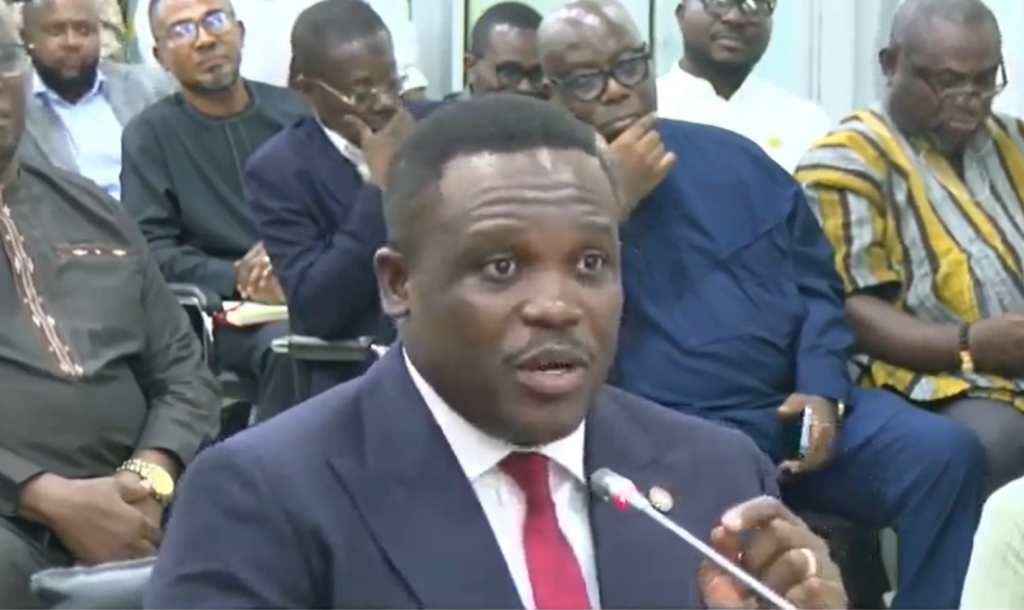
“If you look at the cost build-up for taxation, when you look at a network like Telecel, about 27.65% of their cost build-up is taxes. When you go to a network like MTN it is almost 40%, It’s important that we look at the taxes in there. I know that our government has indicated that we will repeal the Covid Levy for example”.
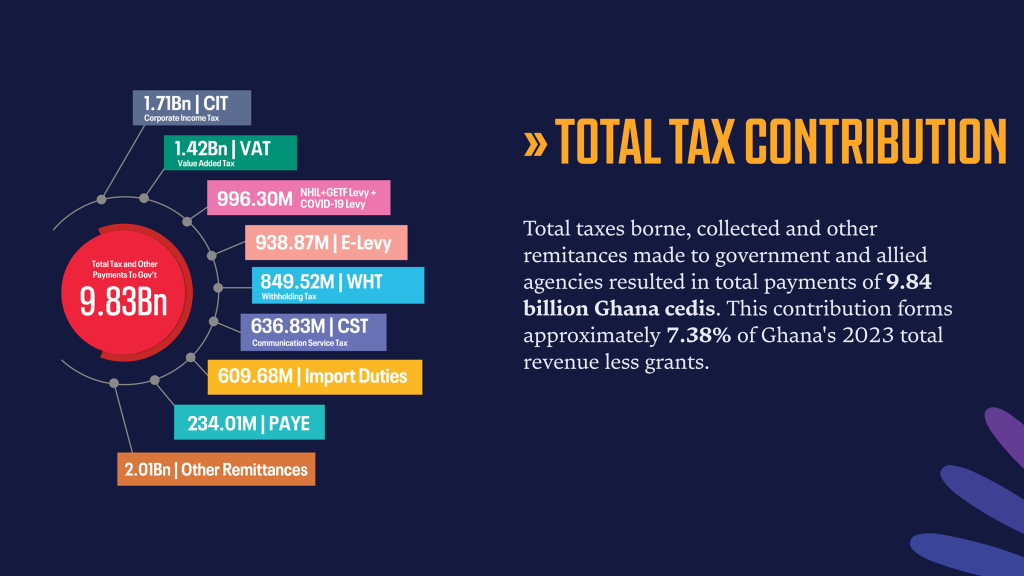
The rising tax burden on Ghana’s telecommunications industry – GHS 9.84 bn in 2023
The cost of spectrum and industry-specific taxes among many others, have made it increasingly challenging for mobile operators to expand service across Ghana. The Communications Service Tax and the Surtax on International Inbound Call Termination for example have proved particularly burdensome for the operators, limiting the amount they can invest in their networks.
The total contribution of the telecommunications industry by way of taxes, fees, levies, and other payments to government in 2023, rose by more than 30%. The industry’s overall taxes and other payments to the government in 2023 rose to GHS 9.84 billion, up from GHS 7.32 billion in 2022.
The contribution of mobile to Ghana’s economy and tax revenues
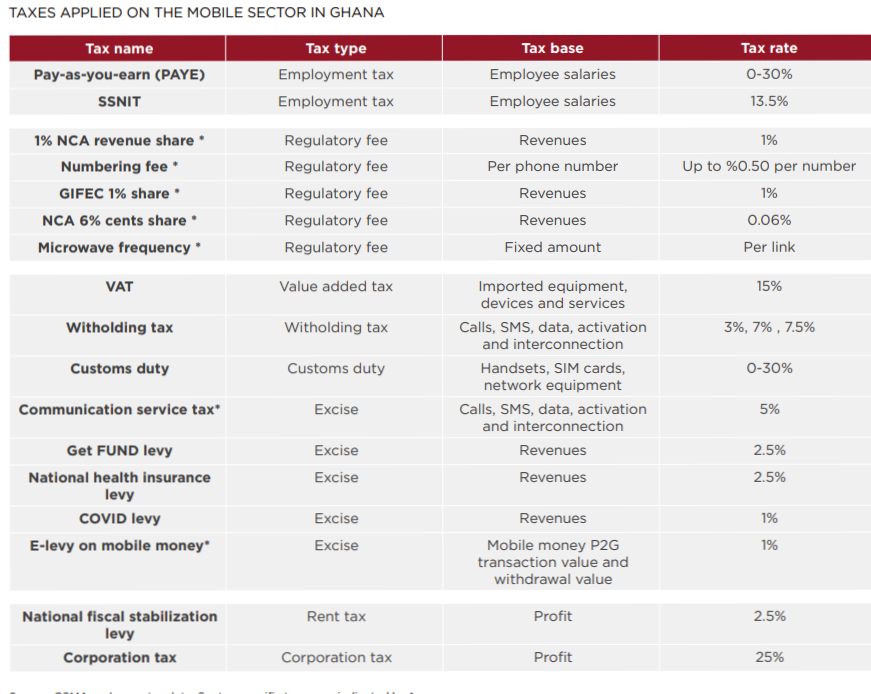
Ghana’s current economic climate and challenges in domestic revenue mobilization have created an urgent need to explore alternative tax revenue streams. The mobile sector, being highly formalized, has become a convenient target for taxation. As a result, mobile consumers and operators in Ghana face a significant tax burden, largely driven by sector-specific taxes and fees.
The mobile sector’s contribution to government tax revenue is substantial, disproportionate to its size in the economy. Various taxes and fees are levied on the sector, including several sector-specific ones. Additionally, the National Fiscal Stabilisation Levy, although not exclusively sector-specific, applies only to selected sectors, including mobile.
The Minister-designate for Communication, Digital Technology, and Innovations, Samuel Nartey George has assured players in the telecommunications industry of his commitment to protect them from players who are not domiciled in Ghana and who do not create jobs for the Ghanaian people. According to him, his bias will be towards businesses in the country that are creating jobs.
He made the assurance, in response to a question during his vetting before Parliament’s Appointments Committee, about how he would handle an entity such as Starlink if he is approved.
“Mr. Chairman, my first obligation if approved by this house and assume the office of Minister will be to the businesses domiciled here in Ghana that create Ghanaian jobs. That is where my bias will be to. And so any external business, that fails to have presence, that can be held to account by the regulator and that creates absolutely no jobs in Ghana, will not get the benefit of that office at the expense of our local businesses domiciled here.”.
“And so the industry can rest assured that, policy will protect investment and policy will protect Ghanaian jobs. Thank you.”,” he added.
More spectrum will be made available to Telcos to improve quality of service – Sam George
The Minister-designate for Communication, Digital Technology, and Innovations, Samuel Nartey George has promised to ensure that Mobile Network Operators (MNOs) in Ghana get more spectrum to help improve the current quality of service in the country.
According to him the management of spectrum will be done in a way that helps maintain the balance in the ecosystem and the strength of the overall sector.
“Mr. Chairman, spectrum is a finite national resource, and so, the management of spectrum is critical for the maintenance of balance and the sector. We’ll continue to look at, maintaining the balance in the ecosystem, maintaining the strength of the sector and taking direction and leading from his Excellency the President”.
“We’ll continue on management of spectrum, in a way that ensures proper quality of service for consumer experience, but also ensuring that the businesses are kept afloat. Thank you,” he added.
The Road Ahead
When confirmed as Minister of Communication, Digital Technology, and Innovations, Sam George is expected to lead initiatives that will drive Ghana’s digital transformation. Key priorities will likely include:
Building a conducive and supportive policy and regulatory environment.
Championing the review of the tax regime especially as it pertains to smartphones, industry specific taxes, VAT and levies on imported services among others.
Championing the protection of industry infrastructure.
Implementation of measures to reduce the cost of doing business and ease of doing business in the telecommunications industry.
Tackling indebtedness of government to industry players.
The Minister-designate for Communication, Digital Technology, and Innovations, Samuel Nartey George has promised to ensure that Mobile Network Operators (MNOs) in Ghana get more spectrum to help improve the current quality of service in the country.
According to him the management of spectrum will be done in a way that helps maintain the balance in the ecosystem and the strength of the overall sector.
He made the remarks during his vetting before Parliament’s Appointments Committee on Thursday January 30, 2025.
“Mr. Chairman, spectrum is a finite national resource, and so, the management of spectrum is critical for the maintenance of balance and the sector. We’ll continue to look at, maintaining the balance in the ecosystem, maintaining the strength of the sector and taking direction and leading from his Excellency the President”.
“We’ll continue on management of spectrum, in a way that ensures proper quality of service for consumer experience, but also ensuring that the businesses are kept afloat. Thank you,” he added.
The Road Ahead
When confirmed as Minister of Communication, Digital Technology, and Innovations, Sam George is expected to lead initiatives that will drive Ghana’s digital transformation. Key priorities will likely include:
Building a conducive and supportive policy and regulatory environment.
Championing the review of the tax regime especially as it pertains to smartphones, industry specific taxes, VAT and levies on imported services among others.
Championing the protection of industry infrastructure.
Implementation of measures to reduce the cost of doing business and ease of doing business in the telecommunications industry.
Tackling indebtedness of government to industry players.
On Thursday, January 30, 2025, Sam George, the Member of Parliament for Ningo Prampram, will appear before Parliament’s Appointments Committee for his vetting.
Appointed by President John Dramani Mahama as the Minister-designate for Communication, Digital Technology, and Innovations, Sam George is hoping for approval of his nomination.
A key figure in the National Democratic Congress (NDC), Sam George (popularly known as “Dzata”) has represented Ningo Prampram since 2016. During President Mahama’s previous term, he worked in the Communications Directorate at the Presidency.
The Ministry of Communication, Digital Technology, and Innovations has the following as its core functions:
Initiate and formulate ICT policies taken into account the needs and aspirations of the people.
Coordinate, monitor and evaluate the efficiency and effectiveness of the performance of the Communications Sector.
Develop appropriate regulations to protect consumers and stimulate competition in the communication sector.