
Egypt Strengthens Position as Digital Talent Hub with Huawei ICT Competition Success

Overall, the teams secured five prestigious international awards, placing Egypt among only eight countries worldwide to receive Grand Prize recognition during the competition’s 10th edition.

Egyptian teams have achieved a remarkable milestone at Huawei ICT Competition 2025–2026 Global Finals, held in Shenzhen, China, by winning two Grand Prizes in Computing and Cloud, securing first place in the Innovation track, and second place in the Network track. In addition, Dr. Mohamed Maher, Faculty of Information Systems and Computer Science, October 6 University, was recognized as The Most Valuable Instructor at the global level.

Overall, the teams secured five prestigious international awards, placing Egypt among only eight countries worldwide to receive Grand Prize recognition during the competition’s 10th edition. This accomplishment further reinforces Egypt’s growing status as a hub for digital talent and innovation.

Egypt’s Cloud and Computing Track teams both secured Grand Prizes at the competition. The Cloud Track team — Abdelrahman Adel Elbahrawy (Ain Shams University), Ahmed Mohamed Abd El Latief Talha (Beni Suef National University), and Mohamed Salaheldin Abouelkhir (Mansoura University) — were recognized for their outstanding performance in cloud technologies and practical problem-solving, while the Computing Track team — Mahmoud Ahmed Alameldin (King Salman International University), Ahmed Omar Nawara (Arab Academy for Science, Technology and Maritime Transport), and Karim Gamal (Ain Shams University) — were awarded for their advanced expertise in computing technologies.

In the Innovation track, students Ibram Anwar, Beshoy Magdy Botros, and Ahmed El-Khouly from Misr University for Science and Technology (MUST) earned First Prize for their Manetho app, an AI-powered translator specifically designed to decode ancient Egyptian hieroglyphs in real-time. While the Network Track team of Rami Khalid Kamal El Din Moharam (Arab Open University), Kerolos Magdy Lotfy Habib (Assiut University), and Mohamed Khaled Eid Youssef (Future Higher Institute of Engineering in Fayoum) secured Second Prize.

Further highlighting Egypt’s contribution to the competition, Dr. Mohamed Maher, Faculty of information systems and computer science, October 6 University, was recognized among only 16 instructors globally to receive the Most Valuable Instructor Award, reflecting the important role of educators in developing the next generation of ICT professionals.

The Global Final concluded the largest edition in the competition’s history, attracting more than 220,000 university students and faculty from over 2,000 higher education institutions across more than 100 countries and regions. Following national and regional rounds, 177 teams from 49 countries and regions advanced to the Global Final.

“The achievements of Egyptian teams at this year’s Huawei ICT Competition Global Final reflect a long-term commitment to talent development and knowledge transfer. At Huawei, our vision of a fully connected, intelligent world starts with empowering people. Through our Huawei ICT Academies in Egypt and collaboration with universities, we are equipping young talents with the digital and AI skills needed for the future economy. We are proud that the Huawei ICT Competition has become a global platform where Egyptian students and educators compete with some of the world’s brightest minds, showcase their innovation and technical excellence, and earn international recognition for their universities and country. These results reaffirm our belief in Egypt’s exceptional talent and its ability to drive the next wave of digital innovation regionally and globally.”

William Zheng, Director of Business Environment Affairs, Huawei Egypt

“Seeing Egyptian talent stand among the world’s best at the Huawei ICT Competition Global Final is a moment of pride for all of us. The achievements of our students and instructors reflect not only technical excellence, but also the ambition, creativity, and resilience that define Egypt’s next generation of digital leaders. As technology continues to transform industries and societies, investing in talent development has never been more important. Huawei remains committed to creating opportunities for young people to learn, innovate, and turn their potential into real-world impact.”

Eng. Asmaa Serag Eldin, Managing Director, Huawei ICT Academies in Egypt

Dr. Shafika Isaacs, Director a.i. of the UNESCO Institute for Information Technologies in Education and Chief of Section for Technology and AI in Education, commended the ongoing partnership between UNESCO and Huawei, which continues to support AI capacity building, ICT education, and talent development across multiple regions, including the Arab world. She emphasized that preparing future generations for the AI era requires close collaboration among governments, academia, international organizations, and industry, and praised the competition participants for their ability to apply emerging technologies to address real-world challenges.

Since 2015, the competition has remained a key platform for talent development and industry–academia collaboration, preparing students for the evolving needs of the digital economy. It has attracted over 960,000 students from more than 2,000 universities and colleges across over 100 countries and regions with Egyptian teams consistently delivering strong results across its tracks.s

Source : www. techafricanews.com

Huawei launches AI-focused EduTech1.0 education framework

Huawei-2

Huawei has launched its EduTech1.0 Framework during the Huawei ICT Competition 2025–2026 Global Final, introducing a new model designed to help educational institutions, governments and industry stakeholders accelerate the transition from digital to intelligent education.

The framework combines artificial intelligence (AI)-enabled learning innovation with digital talent development, aiming to support the creation of more personalised, inclusive and sustainable education ecosystems while preparing learners for the demands of the digital economy.

Huawei said EduTech1.0 adopts an integrated approach that brings together technology infrastructure, educational transformation and ICT skills development to create a structured pathway for future-ready education systems.

The launch comes as countries across the Middle East and Central Asia continue to advance digital transformation agendas and explore the use of AI technologies to enhance learning outcomes and develop future workforce capabilities.

According to Huawei, many educational institutions continue to face challenges such as fragmented learning platforms, difficulties delivering personalised learning experiences at scale, and uncertainty around integrating AI into teaching, student services and institutional management.

To address these issues, the company developed EduTech1.0 as a framework that combines educational innovation, digital infrastructure and talent development into a unified model.

At the centre of the framework is a dual-engine structure comprising two pillars: Tech4Edu and Edu4Tech.

Tech4Edu focuses on applying digital technologies to transform education through AI-enabled learning environments, cloud-based platforms and intelligent network infrastructure. Huawei said the approach is designed to improve operational efficiency, expand access to quality education and support personalised learning experiences.

Edu4Tech, meanwhile, focuses on building future digital talent through information and communications technology (ICT) curricula, professional certifications, hands-on training programmes and online learning platforms.

The initiative places particular emphasis on developing local AI and digital talent pipelines, helping educational institutions equip students with skills in artificial intelligence, cloud computing, networking, cybersecurity and other emerging technologies.

Huawei said the framework is intended to support national efforts to reduce skills gaps, strengthen innovation capacity and build sustainable talent ecosystems for the AI era.

Alfie Liu, vice president of Huawei’s Middle East & Central Asia ICT Marketing & Solution Sales Department, said: “Intelligent education is not simply about introducing new technologies into classrooms. It is about fundamentally reimagining how educational institutions cultivate talent, deliver learning experiences, and prepare learners for an AI-driven future.

“With EduTech1.0, Huawei proposes a holistic framework that brings together intelligent education transformation and digital talent development. By connecting technology, learning, and industry needs, we aim to help educational institutions build more resilient, inclusive, and future-ready education ecosystems, while empowering countries to cultivate their own AI talent and innovation capabilities for long-term sustainable development.”

Dr. Shafika Isaacs, director a.i., UNESCO Institute for Information Technologies in Education and chief of Section for Technology and AI in Education, also highlighted the importance of ensuring AI-driven educational transformation remains inclusive and equitable.

She said: “Artificial intelligence presents a historic opportunity to reimagine education, but technology alone cannot transform learning. Meaningful transformation requires a shared commitment to equity, quality, and human-centered innovation. As education systems adapt to the digital age, our collective responsibility is to ensure that technology expands opportunities for all learners while helping societies develop the knowledge, skills, and values needed for a sustainable future.”

Huawei said the framework is designed to create a virtuous cycle in which technology enhances learning outcomes while education systems cultivate future innovators, ultimately supporting long-term economic and social development.

Source :  www. gulfbusiness.com

Zamtel and Ericsson sign MoU to advance private 4G and 5G connectivity in Zambia

Zamtel has signed a Memorandum of Understanding (MoU) with Ericsson to support the rollout of private 4G and 5G connectivity solutions in Zambia, in a move aimed at accelerating digital transformation and strengthening enterprise connectivity.

The agreement was formalised during a visit by a delegation from Ericsson led by the Head of Eastern and Northern Africa, Mr. Alain Maupin.

The partnership is expected to enable the deployment of private network solutions designed to provide secure, high-performance connectivity for businesses across key sectors of the economy. These solutions are intended to enhance operational reliability, improve efficiency, and support increased automation and innovation within enterprise environments.

According to Zamtel, the collaboration forms part of its broader strategy to leverage strategic partnerships and emerging technologies to advance Zambia’s digital agenda.

The telecom operator said the initiative will contribute to building a more connected digital ecosystem for businesses and communities, while supporting national efforts to expand access to advanced communication infrastructure.

Ericsson’s involvement is expected to bring global expertise in network technologies to the partnership, supporting the development and deployment of next-generation connectivity solutions in the country.

The two organisations reaffirmed their commitment to working together to accelerate digital transformation and enable the growth of innovative, technology-driven services in Zambia.

Source : www. techreviewafrica.com

MTN Ivory Coast: Abbad Reda appointed CEO from September 1st

MTN, the largest telecoms group in Africa, is seeking to strengthen its position on the continent in the face of strong demand and increased competition. In Côte d’Ivoire, the operator competes directly with Orange and Moov Africa.

South African telecommunications group MTN has appointed Abbad Reda (pictured) to head its Ivorian subsidiary. He will take up his post on September 1st, replacing Mitwa Ng’ambi.

Announced on Tuesday, June 2nd, this appointment is part of a reorganization of the group’s leadership teams. Mitwa Ng’ambi will join MTN headquarters as Chief People and Culture Officer, replacing Paul Norman, who is retiring. Abbad Reda will be replaced as head of MTN Zambia by Larry Annetts.

At the helm of MTN Côte d’Ivoire, Abbad Reda will primarily focus on implementing the group’s strategic ambition, dubbed “Ambition 2030.” Within this strategy, the operator seeks to capitalize on growth opportunities linked to digital and financial inclusion in Africa.

Digital and financial inclusion at the heart of the strategy

The digital inclusion outlined in the strategy involves expanding telecommunications networks to connect more people, particularly in underserved areas, and to reduce disparities in access to digital services. Financial inclusion, meanwhile, aims to broaden access to basic financial services, such as mobile payments, money transfers, savings, and credit, through digital solutions.

It is in this context that MTN Côte d’Ivoire announced last April an investment plan of 200 billion CFA francs (approximately USD 355 million) by 2028. This plan covers the widespread rollout of 4G, the use of satellite technology to accelerate coverage, and the strengthening of home connectivity via fiber and satellite. In the area of ​​mobile money, the operator is also introducing an overdraft solution that allows users to complete a transaction when their balance is insufficient.

These efforts aim to strengthen the operator’s position in a telecoms market where mobile phone penetration is 65.3% and internet penetration is 41.4%, according to the International Telecommunication Union (ITU). Competition is also fierce, driven primarily by Orange.

According to data from the Telecommunications/ICT Regulatory Authority of Côte d’Ivoire (ARTCI), Orange held a 51% market share at the end of March 2026, compared to 28% for MTN and 21% for Moov Africa. However, in the mobile internet segment, MTN is neck and neck with its main competitor, with a 37% market share, compared to 38% for Orange and 25% for Moov Africa.

To carry out his mission, Abbad Reda, according to MTN Group, has experience gained through several management positions, notably in Afghanistan, Liberia, Ghana, and most recently Zambia. “He is recognized for his ability to turn around operations, drive innovation, and exceed targets, with a strong customer focus and solid experience in growing market share, revenue, and profits ,” the company statement reads.

Source : www. extensia.tech

Telecel, AirtelTigo and Ibrahim Mahama, step up for Ghanaian evacuees from South Africa – Ablakwa reveals

Ghanaian business magnates and multinational corporate giants have mobilised to partner with the government to provide comprehensive livelihood restoration and full economic integration for citizens evacuated from South Africa.

The Minister for Foreign Affairs and Regional Integration, Samuel Okudzeto Ablakwa, revealed the private sector intervention on Saturday night, June 6, 2026, at the Accra International Airport while welcoming the second batch of 345 Ghanaian evacuees who fled raging anti-immigrant violence in South Africa.

Addressing the returnees, many of whom were visibly distraught after watching their retail shops, savings, and decades of hard work destroyed by xenophobic rioters, the minister announced that corporate Ghana refuses to remain a passive bystander in the face of national distress.

The Private Sector Response

According to the minister, some of the country’s most influential business leaders and telecommunication executives have proactively reached out to the state apparatus to establish a structural economic cushion for the displaced returnees

The corporate intervention aims to deploy substantial capital, digital tools, employment slots, and business integration packages to ensure that no evacuee is left destitute upon their return to the country.

Announcing the arrival of the private sector rescue partnership, Mr Ablakwa stated:

“Ibrahim Mahama, AirtelTigo and Telecel, they have also reached out, and there are many other CEOs calling that they are all going to be part of this programme. They are not going to sit back and just watch you having lost everything, lost your businesses, lost your investments, and lost your assets. They are going to partner with the government to make sure that you are fully integrated.”

The inclusion of prominent industrialists like Ibrahim Mahama, the founder of Engineers and Planners, alongside telecom heavyweights Telecel and AirtelTigo, signals a major shift toward long-term professional rehabilitation rather than temporary emergency relief.

The partnership will likely focus on providing technical training and direct entrepreneurial seed capital to help returnees establish new commercial enterprises within the 16 regions of Ghana.

The emergency evacuation exercise, swiftly launched by the Ministry of Foreign Affairs in coordination with Ghana’s high commission in Pretoria, was triggered by targeted attacks, intimidation, and the widespread looting of foreign-owned properties across South Africa.

The arrival of Saturday night’s flight brings the total number of successfully rescued citizens to nearly 700, following an initial batch of approximately 300 evacuees who safely touched down in Accra on May 27.

Comprehensive On-Arrival Support

Immediately following the minister’s briefing, officials from the National Disaster Management Organisation (NADMO) and the Ghana Immigration Service (GIS) began categorising the returnees based on their professional skill sets, trade backgrounds, and immediate economic needs.

The data collected will be used to streamline the corporate integration pipeline backed by the volunteer CEOs. In the interim, each evacuee received emergency mobile SIM cards from the telecom partners, psycho-social trauma counselling, and an immediate transport stipend to travel back to their families.

With a third emergency flight carrying over 300 additional passengers expected to touch down at the airport today, Sunday, June 7, 2026, the Foreign Ministry has reiterated its resolve to maintain maximum speed in securing both the physical safety and the long-term financial future of all citizens fleeing the South African crisis.

Source : www.myjoyonline.com

Ericsson and Epiroc Expand Alliance to Accelerate Mining Digitalization

The companies are expanding their longstanding relationship into a broader go‑to‑market alliance designed to help mining companies accelerate automation, digitalization, and operational transformation.

As industrial enterprises increasingly turn to digitalization to enhance safety, productivity, and sustainability, Ericsson and Epiroc are evolving their global relationship to accelerate this transformation within the mining sector. The companies are expanding their longstanding relationship into a broader go‑to‑market alliance designed to help mining companies accelerate automation, digitalization, and operational transformation.

Under the agreement, Epiroc, a leading productivity and sustainability partner for the mining and infrastructure industries, will offer Ericsson’s robust LTE and 5G connectivity solutions as part of its comprehensive digital portfolio for both surface and underground mines. This integrated approach makes it easier for mining customers to deploy secure and high-performing wireless networks, laying the foundational layer for scaling automation, remote operations, and predictive maintenance. By combining Ericsson’s technology leadership with Epiroc’s deep domain expertise and global footprint, the partnership addresses the growing demand for connected, resilient operational technology (OT) ecosystems.

Epiroc is empowered to further its position as a performance partner, supporting its customers by seamlessly integrating the Ericsson Private 5G solution with its own digital offerings, including telematics, vendor-agnostic remote-control solutions, and systems for situational awareness and collision avoidance.

“Connectivity is becoming increasingly important as mining companies advance automation and digitalization throughout their operations. Together with Ericsson, we are strengthening our offering and helping customers build the robust communications infrastructure needed to enable safer, more efficient, and more productive mining operations.”

Paul Bergström, President, Epiroc’s Digital Solutions division

“This collaboration is about enabling real operational impact for mining customers—safer operations, higher productivity, and greater efficiency. By providing the connectivity foundation behind Epiroc’s digital and automation solutions, we are helping mining companies modernize operations at scale. Our partnership with Epiroc is an important step in building the connected ecosystems that modern industrial enterprises depend on.”

Pankaj Malhotra, Head of Product and Engineering, Ericsson Enterprise Wireless Solutions

The agreement builds on a collaboration established in 2018, when Epiroc and Ericsson signed a cooperation agreement to explore how LTE and 5G technologies could be applied in mining operations.

Source : www. techafricanews.com

220,000 Flock to ‘Huawei Olympics’ as China Accelerates Talent Drive in Middle East, Africa

The Shenzhen International Convention Center in Guangdong Province, China, on the 4th. On the day the awards ceremony for the 10th “Huawei ICT (Information and Communications Technology) Competition” was held, following three days of preceding events, the venue was bustling from early morning with students of various skin tones and attire. Wearing matching uniforms and each holding their national flags, the students sat in the audience with elated expressions, beaming with laughter. One team from Italy, though they did not make it to the podium, approached this reporter to ask for a commemorative photo, saying they wanted to preserve the memory of the day.

Each time a winning team was called, applause and cheers erupted as if an Olympic gold medalist had just been born. Among them, the team that drew the most spotlight was the Kenyan team that won the grand prize in the cloud category. According to local media, the Kenyan team’s grand prize win was the first in the competition’s 10-year history. Before boarding their flight to China, they received a commendation from Kenya’s Minister of Information and Communications Technology, being treated as national heroes.

The Huawei ICT Competition, held from the 3rd to the 6th, has firmly established itself as a true festival for global ICT talent. This year’s competition, marking its 10th edition, drew more than 220,000 students and teachers from over 100 countries and regions and more than 2,000 higher education institutions. After qualifiers, 177 teams from 49 countries and regions advanced to the finals, and 18 teams from eight countries — China, Nigeria, Singapore, Algeria, Brazil, Egypt, Kenya, and the Dominican Republic — won grand prizes. Participants competed with ideas across various fields including artificial intelligence (AI), computing, and cloud.

Winning in the competition leads directly to a smooth career path. Advancing to research labs at China’s prestigious universities is common. This is because China’s Ministry of Education has officially certified the competition as a university student competition, allowing winners to receive bonus points when applying for graduate school. The Central China Normal University team that won third prize last year went on to graduate programs at renowned Chinese institutions such as the Chinese Academy of Sciences, Beijing Normal University, and Fudan University. Many also join Huawei. Mohammed Alkooheji, the Bahraini student who took first place in last year’s finals, recently obtained a full-time position as an internet protocol (IP) engineer at Huawei after graduation.

What stood out particularly in the competition was the advance of talent from the “Global South” — developing countries in the Southern Hemisphere — including Africa, Latin America, and Southeast Asia. This is because Huawei is actively recruiting talent from these countries that are favorable to China. In fact, the ICT Competition holds qualifiers by region, including the Middle East and Central Asia, Southern Africa, Asia-Pacific, North Africa, Latin America, and Europe. Excluding China (154,000 people), the Global South was overwhelmingly dominant, in the order of the Middle East and Central Asia (25,000 people), Southern Africa (12,000 people), and North Africa (9,000 people). Europe accounted for only about 1,000 people, and no qualifiers were held for North America at all.

There is an assessment that Huawei, a leading Chinese ICT company, is rolling out a “Belt and Road” approach in securing talent as well. Beyond the ICT Competition, Huawei has provided its practice-oriented ICT curriculum, the “Huawei ICT Academy,” to more than 3,000 universities and institutions, producing over 1.3 million students. It has also been running “Seeds for the Future,” which invites university students worldwide to Huawei headquarters to provide ICT education and networking opportunities, for more than 10 years. In South Korea, more than 7,000 students have gone through this program over the past 10 years.

Huawei provides the best environment and rewards to the talent it discovers in various regions. A representative example is the “Xicun Campus,” an R&D base in Dongguan that Chairman Ren Zhengfei, a graduate of Chongqing University’s architectural engineering department, personally participated in designing. This site, visited on the 3rd, spans a vast 1.8 million square meters — the equivalent of 250 soccer fields — where 112 buildings inspired by 12 European cities such as Heidelberg in Germany and Paris in France are lined up, creating the illusion of being at a theme park. Here, 25,000 researchers reside, carrying out various R&D centered on the device sector.

Amid its competition with the United States for technological supremacy, China is staking everything on attracting talent, with not only the state but also companies and local governments stepping in directly. From October last year, the government established the K-visa, targeting young science and technology talent holding a bachelor’s degree or higher in STEM (science, technology, engineering, mathematics) fields. By allowing individuals to apply directly without an employer’s invitation, it has significantly lowered the threshold for entry into China. Shenzhen, where Chinese tech companies including Huawei, Tencent, and BYD are concentrated, has been running the “Peacock Plan,” an overseas high-level talent recruitment project, since 2011. Through last year, it provided a total of 10 billion yuan to more than 300 startup teams, of which 12 teams successfully went public. At the same time, China is increasingly strictly blocking the outflow of its own talent abroad, imposing exit restrictions on engineers from private companies such as Alibaba and DeepSeek.

Source: www. en.sedaily.com

Ghana Reviews Draft Bills to Strengthen Digital Laws

 Communications Minister Samuel Nartey George has reviewed ten Cabinet memoranda on draft digital bills and met agency heads in Accra to refine laws on technology, cybersecurity and data protection.

George chaired the technical review with chief executives of the ministry’s information and  communications technology (ICT) agencies, alongside technical and legal officers who helped draft the proposed legislation.

Legal consultants hired by the ministry and representatives of IMANI Ghana, a public policy think tank supporting the review, also joined the session. The meeting examined the minister’s findings and the current versions of the bills.

The bills target Ghana’s legal and regulatory framework for digital technology, cybersecurity and data protection, part of what the ministry calls the broadest overhaul of the country’s communications law since 1996.

Officials said the engagement reflects the ministry’s push for wide stakeholder consultation and policymaking grounded in evidence as Ghana expands its digital economy.

The ministry has named legislative reform a key pillar of its drive to build a secure, inclusive and competitive digital sector, with the review feeding laws meant to spur innovation, harden cybersecurity and protect personal data.

Source : www.newsghana.com.gh/

MTN Nigeria Defends Data Depletion, Assures Customers of Better Service Quality

MTN Nigeria has offered explanations on why telecoms customers experience fast data depletion on their mobile devices.

The telecoms company also assured customers of fresh plans to increase investment on telecoms infrastructure upgrade in order to achieve uninterrupted customer service experience on its network.

MTN made the defence and gave the assurance during a public customer forum in Lagos, tagged: ‘Data On Trial’ (DOT), designed to offer explanations to consumers’ complaints about fast data depletion.

Addressing participants at the public forum, the Chief Executive Officer of MTN Nigeria, Karl Toriola, encouraged participants and prosecutors representing different subscriber constituencies to feel free in asking questions concerning their feelings about data depletion and their experiences in service quality.

One of the prosecutors, who identified himself as Timi Agbaje, demanded to know why subscribers’ data deplete too fast on the MTN network, and further asked if MTN had resolved such complaints in favour of the subscribers in the last 12 months.

Responding, MTN technical team members that stood as defenders, explained how the team had invited subscribers to the MTN office in Lagos to show them the back-end of MTN operations on how their data is consumed.

According to the defendants, MTN is transparent in its data service offering and will not intentionally deplete customer data for selfish gains.

Source : www.thisdaylive.com

Telecel Ghana Plants 10,000 Trees, Pushing Reforestation Total to 43,000 Trees

IMG_2874

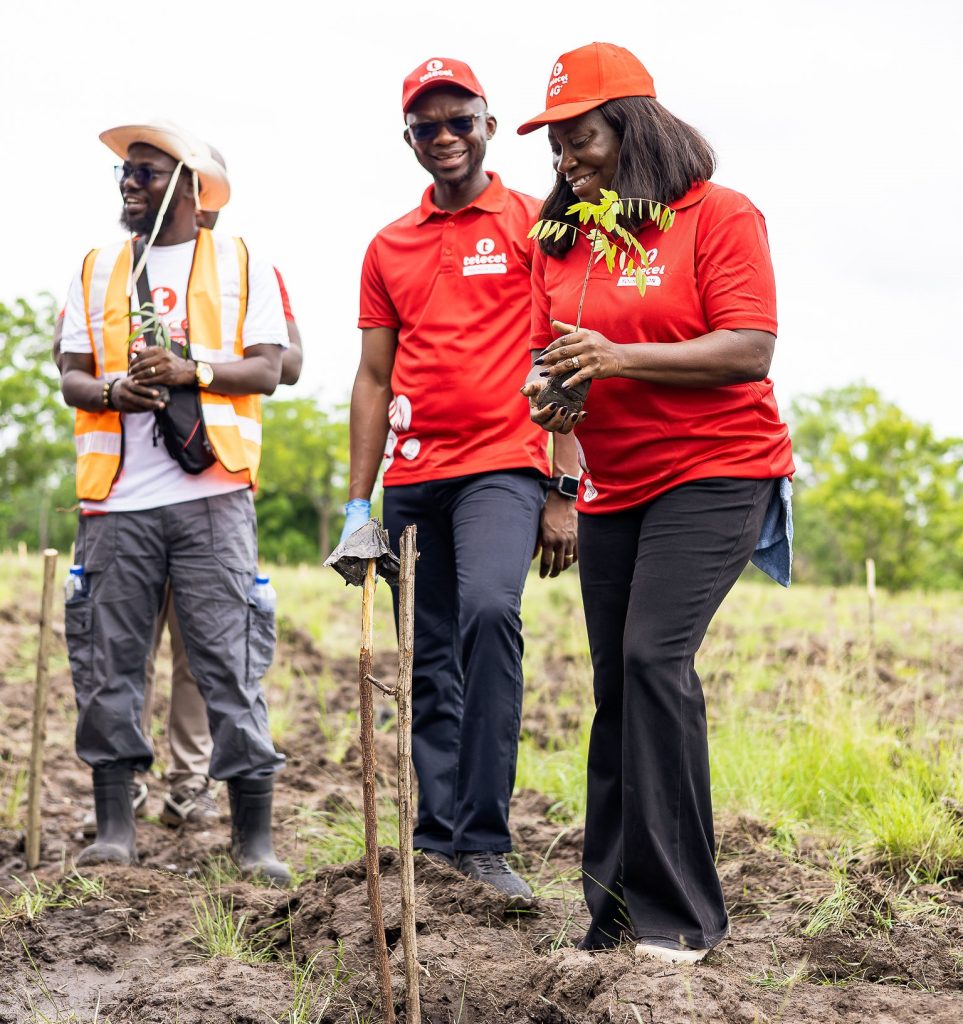
(Telecel Ghana CEO, Ing. Patricia Obo-Nai leads a team of over 250 employees to plant 10,000 trees to mark World Environment Day.)

Over 250 employees from Telecel Ghana and a score of students from the Kordiabe R/C Basic School volunteered to plant 10,000 seedlings in the Chipa Tributary Forest Reserve in the Shai-Osudoku District of the Greater Accra Region to mark World Environment Day.

Organised in partnership with the Ghana Forestry Commission, the reforestation activity brings the telecom operator’s total tally of trees planted to 43,000 in the last five years, making it one of the largest reforestation efforts by a corporate organisation in Ghana. 

The tree-planting exercise brought together the senior management team and employees, students from the local community, officials of the Forestry Commission, and local leaders. The activity aligns with the Government of Ghana’s Tree for Life Campaign, which calls on businesses and citizens to accelerate the country’s reforestation agenda.

Leading hundreds of staff to plant the seedlings, Telecel Ghana’s Chief Executive, Ing. Patricia Obo-Nai said the reforestation exercise is a demonstration of a long-term annual commitment to restore the ecosystem and contribute significantly to environmental sustainability.

“We believe that a connected Ghana must also be a green Ghana. As a business that priorities purpose beyond profit, environmental responsibility is integral to how we operate. Every seedling planted today is laying the roots for a sustainable future for the next generation,” Ing. Obo-Nai said.

The Forestry Commission, which selected the Chipa Forest Reserve as the tree-planting site, said the collaboration was critical to Ghana’s national reforestation goal, with a target of planting 30 million trees across the country starting this year.

“Telecel has been helping the Forestry Commission over the years to help restore forest cover in degraded forest reserves like this one and that supports our fight against climate change. We are grateful that you come in every year to plant 10,000 trees to help green Ghana,” Linda Ansah, District Manager for Tema-Ada Forest District, said.

The Chipa Forest Reserve, located in the eastern part of the Greater Accra Region, has faced pressure from human encroachment, illegal logging and sand winning. The planting exercise targeted degraded sections of the reserve, with plant species, Acacia and Cassia, selected for their ecological value and long-term canopy coverage.

The local students who joined the activity said the experience was a learning moment. Edmund Odei, a form two student of Kordiabe R/C Basic School, believes environmental conservation is a collective responsibility and critical to human survival.

“I’m participating in today’s tree planting exercise with Telecel Ghana because our environment needs a lot of trees to help us with air quality and survival. My message to the world as we mark World Environment Day is to avoid deforestation and participate more in afforestation because if the last tree dies, the last man dies.”

Despite the challenging wet conditions of the field, senior leadership and employees of the telco embraced the opportunity to contribute meaningfully to reforestation and climate action. Elsie Mensah, a Brand and Communications Manager with the Enterprise Business Unit, said the planting activity was rewarding and fulfilling.

“We decided to volunteer to plant trees because we believe it is an investment in the future of our country and the health of our environment. Although the wet conditions of the ground made the activity challenging, it was a rewarding experience knowing that every tree planted today will sustain the future of our environment.”

Telecel Ghana said its environmental programme is anchored in its Sustainability agenda, a structured commitment to operating in a way that reduces its ecological footprint. Beyond tree planting, Telecel Ghana has in recent years directed attention to reducing the carbon footprint of its network infrastructure, expanding solar-powered network exchanges, and investing in digital tools that reduce the need for physical travel.

Ghana has lost significant forest cover over the past three decades, and climate researchers believe restoring it requires resources, coordination, and sustained effort from both the government and the private sector.

Telecel Ghana’s 43,000-tree milestone makes it the largest single corporate contributor to Ghana’s reforestation effort to date. It says it will continue to plant trees annually, with targets set to rise in the years ahead.