Becomes member of Ericsson’s Executive Team, reporting to the CEO
Ericsson has announced the appointment of Charlotte Levert as its new Chief People Officer, Senior Vice President, and Head of Group Function People. Charlotte Levert who is currently Vice President and Head of People Business Area Cloud and Software Services will replace MajBritt Arfert, whose departure Ericsson announced in October 2024. Charlotte Levert will take up her new position on February 10 and will be based in Sweden.
Charlotte Levert has held executive positions within Ericsson across several business areas. She has most recently held the position of Head of People Business Area Managed Services. Before joining Ericsson, Charlotte Levert was Head of HR Sweden & Global HR business partner at Tieto and has held various senior management positions within human resources. She holds a Bachelor in Business Management & Human Resources.
Börje Ekholm, President and CEO of Ericsson, says: “Charlotte will be an integral part as we are entering the next chapter of Ericsson’s strategy and in the continued evolution of the People agenda. She brings a strong track record from different organizations including different parts of Ericsson and I’m very much looking forward to having Charlotte join the Executive Team.”
Commenting on the appointment, Charlotte Levert says: “I am truly honored to take on this role and grateful for the trust. Working at Ericsson means we all get the chance to be part of shaping the future. I am looking forward to co-creating a future-proof organization and where Ericsson remains a great place to work.”
In October 2024 Ericsson announced that MajBritt Arfert would step down after having been with Ericsson for over 38 years and a member of the Company’s Executive Team since the autumn of 2016. MajBritt Arfert will be available for Ericsson during the spring and leave Ericsson at the end of May 2025.
Communications, Digital Technology, and Innovation Minister Sam George has announced the formation of a new team that will work towards developing a comprehensive roadmap aimed at addressing the needs of all stakeholders in Ghana’s digital landscape.
A statement shared via social media said the team’s efforts will focus on identifying common ground that balances the interests of citizens, the telecommunications industry, and the government.
The team comprises representatives from key institutions, including the Ministry of Communications, Digital Technology & Innovation, the Ministry of Energy, Ministry of Finance, the National Communications Authority (NCA), the Public Utilities Regulatory Commission (PURC), the Ghana Chamber of Telecommunications, the National Union of Ghana Students (NUGS), and the Association of Content Creators, among others.
Expressing optimism on the outcome, the Minister said, “It is my hope that this team will come up with a workable plan that sees an increase in value on data offerings across the board.”
The Bank of South Sudan (BOSS) has announced a groundbreaking initiative to launch the country’s first National Instant Payment System (NIPS), in collaboration with the AfricaNenda Foundation. This transformative project marks a pivotal milestone in the modernization of South Sudan’s financial and payment infrastructure, advancing the bank’s commitment to providing enhanced financial services for all citizens. The initiative also aligns with broader efforts to integrates t other critical infrastructures, such as Automated Clearing House (ACH) and Real-Time Gross Settlement (RTGS) systems and instants fund transfer (IFT)
The National Instant Payment System is designed to enable real-time, secure, and cost-effective transactions, promoting interoperability between banks, mobile money providers, and other financial institutions. As the backbone of South Sudan’s digital payment ecosystem, NIPS will facilitate a wide range of financial transactions, including person-to-person (P2P), person-to-business (P2B), government-to-person (G2P), and person-to-government (P2G) payments, fostering greater inclusivity and efficiency in the financial sector.
The start of the NIPS journey marks a monumental step forward for financial and socio-economic inclusion in South Sudan. This partnership with AfricaNenda Foundation is pivotal in transforming the financial services landscape, fostering greater inclusivity, and creating a more resilient digital economy.
– Johnny Ohisa Damian Governor of the Bank, South Sudan
Key areas of focus for the partnership include:
Developing a detailed roadmap for NIPS implementation, with clear milestones. Building the capacity of BOSS and financial institutions to effectively oversee and manage the system. Ensuring integration and interoperability by collaborating with banks, telcos, and other stakeholders. Following the successful 2023 proof-of-concept phase, which demonstrated high demand and feasibility, BOSS and AfricaNenda are confident that NIPS will reshape South Sudan’s financial ecosystem. Beyond increasing financial accessibility, the system will empower businesses, streamline government operations, and enable citizens to thrive in a modern digital economy.
This initiative uunderscores BOSS’s commitment to building a sustainable, innovative, and inclusive financial future for all South Sudanese citizens.
We are proud to partner with the Bank of South Sudan on this landmark initiative. Instant payment systems are transformative tools that redefine access to financial services and promote inclusivity. With the launch of this system, South Sudan is laying the foundation for a more connected and resilient economy that benefits every citizen.
Dr. Aminu Maida, CEO of the Nigerian Communications Commission (NCC), and Swedish Ambassador to Nigeria, Annika Hahn-Englund, signed a grant agreement with SWEDFUND last week to fund a crowdsourcing quality of experience project.
SWEDFUND is Sweden’s development finance institution that invests in viable and sustainable projects in low and middle-income countries in Africa, Asia, Latin America, and Eastern Europe.
On the Nigerian initiative, the NCC stated that it will use real-time data to provide insights into user experience and network performance.
It went on to say this will help inform regulatory decisions and guide the expansion of connectivity in underserved areas across Nigeria.
The NCC added: “It will empower the NCC to monitor network performance in real-time, identifying and addressing issues such as dropped calls, slow internet speeds, and weak coverage.
“With such valuable data, the NCC will hold telecom providers more accountable, ensuring better service delivery for consumers.
“This is a significant step toward enhancing connectivity in Nigeria and has the potential to set a benchmark across Africa.”
A Google release of latest updates to its Gemini generative AI product was overshadowed by reports the company had become the latest US tech giant to ditch diversity, equity and inclusion (DEI) goals to pander to the nation’s new President.
The Wall Street Journal led the way, reporting Google told staff it planned to drop recruitment targets involving groups which traditionally were not well represented.
Google also intends to appraise some elements of its DEI programmes, the newspaper wrote.
Forbes explained Google told staff about the move yesterday (5 February), outlining an intention to continue to support “underrepresented staff”, while reconsidering its stance on broader DEI programmes and reporting.
In a video accompanying Google’s 2024 Diversity Annual Report, chief diversity officer Melonie Parker argued the company had learned “making space for diverse perspectives and experiences is inseparable from innovation”.
The report summarised Google’s work in 2023, its 25th anniversary year and one in which Parker said it doubled its efforts to create “a workplace where everyone feels supported”.
“At Google, we’ve seen how the best of technology empowers people of all backgrounds.”
Parker highlighted the creation of “equitable pathways in tech education”, increasing “access to technology” and backing of organisations which advanced “equity in their neighbourhoods and the world beyond them”.
Gemini 2.0 Details of Google’s DEI move broke the same day it advanced development of its Gemini 2.0 Flash agentic AI model by making it widely available through its related API in its various developer studios.
Koray Kavukcuoglu, CTO of Google DeepMind, stated in a blog the release means developers “can now build production applications” using the model, with availability coming two months after the company released an experimental edition.
Google also released an experimental version of its related coding performance and complex prompts model Gemini 2.0 Pro, along with previewing a slimline version of its Flash product which Kavukcuoglu described as its “most cost-efficient model yet”.
The data protection watchdog in South Korea issued a warning to consumers about using the new Chinese AI platform DeepSeek, following a number of ministries blocking its use by employees, Yonhap News Agency reported.
Due to concerns over the start-up’s data management practices, the Personal Information Protection Commission said it is reviewing how the service uses personal data and urged caution when using the generative AI tool.
The commission stated in a briefing it is cooperating with other data protection organisation around the world, including the UK’s Information Commissioner’s Office, the news agency wrote.
Earlier in the week, South Korea’s industry, foreign and defence ministries blocked internal assess to the service after the government advised ministries and agencies to use caution when using AI services including DeepSeek and ChatGPT.
Australia’s government announced on February 4 all DeepSeek products, applications and services would be immediately removed from government networks.
Italy and Taiwan also moved to block the AI service.
The European Union (EU) unveiled fresh guidelines under its AI Act focusing on prohibited uses of the technology, as it pushes forward with the regulatory framework that has attracted opposition from industry heavyweights.
The AI Act, first unveiled in 2023, categorises AI technologies into minimal, transparency, high, or unacceptable risk levels, moving to ban systems that pose a threat to safety and fundamental rights. The latest measures, released by the European Commission on Tuesday (4 February), provide detailed guidance on how the rules will apply.
Under the new guidelines, which came into effect from 2 February, AI systems that carry out “manipulative, exploitative, social control or surveillance practices” are barred from the EU. This includes AI practices such as predictive social scoring, mass biometric surveillance and scraping internet sources or CCTV footage to build facial recognition databases.
The legislation also mandates transparency requirements for companies developing “high-risk” AI systems, which servepublic servicefunctions including healthcare, credit-scoring, and migration. Developers of more advanced AI models face even stricter obligations including mandatory human oversight of AI systems and risk assessments.
National regulators will oversee the enforcement of the act, with non-compliant companies facing hefty financial penalties of up to €35 million or higher with respect to their global annual revenue. Companies engaging in prohibited AI practices could also be hit with a ban from operating in the EU.
However, the framework exempts select areas from its scope including national security tasks, third-country authorities or international organisations using AI for law enforcement, and pre-market AI research and development.
Industry pushback Several tech giants including Meta Platforms have raised concerns over the stringent regulations, arguing they could crush AI innovation and investment. In response to the latest announcement, head of global affairs at Meta, Joel Kaplan, announced the company will not join the EU’s AI Code of Practice, calling it “unworkable” and claiming it imposes unnecessary burdens on open-source AI models.
Meanwhile, US President Donald Trump has warned the EU against targeting US tech companies, while hinting at possible retaliatory measures targeting businesses in the bloc. “We have some very big complaints with the EU,” he said last month.
Despite the criticism, an EU official told Financial Times the regulatory body’s stance on AI remains firm. “What we can do is ensure that it is as innovation-friendly as possible, and that’s what we’re doing right now,” he added.
Senior Google executives defended a shift in its AI ethics policy which opens the door for its technology to be used in military applications as a change necessary to defend the principles of democracy.
Various news outlets noted updated Google AI Principles omit wording about employing the technology for harmful purposes including weapons development or surveillance which had been fundamental to its approach since 2018.
Bloomberg, BBC News and others noted Google’s latest principles drop a commitment to ensure AI was not used in ways “likely to cause” harm, pointing to weapons development as a key example.
In a blog, the tech giant’s SVP of research, labs, technology and society James Manyika, and Demis Hassabis, CEO and co-founder of Google DeepMind, delved deeply into the company’s AI credentials and transparency, but added the ongoing development of the technology required it to adapt.
The executives noted emerging AI capabilities “may present new risks”, because it had evolved from being a “niche research topic in the laboratory to a technology that is becoming as pervasive as mobile phones and the internet itself”, which is used by “billions of people”.
They argued governments, companies and other organisations should work together to develop principles which promote national security, among other goals.
Experts told Bloomberg the reworked governance principles would likely lead to AI being used in more nefarious ways, though the news outlet noted Google’s move comes at a time of a broader hardening of attitudes among large technology players, including the removal of fact checking and diversity programmes.
Orange signed a contract extension with Nokia to upgrade its 5G radio infrastructure in France, a deal which includes a trial of the vendor’s cloud RAN solutions to assess a transition of the operator’s network towards the technology.
The agreement marks another big deal struck by Nokia this week, after it agreed an extension with US operator AT&T to upgrade the company’s voice core and aid a network automation push.
Under the latest four-year agreement, Nokia noted it would supply Orange France with equipment from its open-RAN compliant 5G Airscale portfolio, all powered by its ReefShark System-on-Chip technology to provide “superior coverage and capacity”.
Nokia added it would also supply AI-powered network management services, supporting all radio and mobile core technologies.
On the cloud RAN aspect of the deal, Nokia explained it is already helping global operators transition to a more-cloud based network approach. Orange will trial its anyRAN system, allowing the operator to assess “strategic options” for RAN evolution with purpose-built hybrid or cloud RAN solutions.
Nokia is starting to see traction with its 5G cloud RAN offering. It deployed the service for Finnish vendor Elisa at the end of 2024, a move the companies claimed as a European first.
Emmanuel Lugagne Delpon, CTO at Orange France stated the deal with Nokia would support its “pioneering efforts to drive superior customer experience further, reduce our environmental footprint and make our network as energy efficient as possible”.
5G is being positioned as the future of connectivity —powering everything from AI-driven industries to smart agriculture and autonomous systems. It’s fast, efficient, and capable of transforming economies. In Sub-Saharan Africa, 5G’s contribution to the economy is projected to reach $10 billion by 2030 (GSMA), accounting for 6% of the overall economic impact of mobile. By the end of 2023, global 5G connections had surpassed 1.5 billion, making it the fastest-growing mobile technology in history.
But while the rest of the world surges ahead with 5G, Sub-Saharan Africa still faces a different reality—one where 3G remains the primary network for millions of people, and 4G adoption is progressing at a considerably steady pace, and some are even still using 2G. As of 2023, only about 31% of mobile connections in Sub-Saharan Africa were on 4G and 1.2% on 5G (though expected to increase to 50% and 17% respectively by 2030). This seemingly slow transition isn’t just about infrastructure; high device costs, affordability barriers, and uneven network coverage mean that for many, even 4G remains out of reach.
So, how do we talk about 5G’s potential when millions of Africans are still unconnected?
The reality is, we can’t just skip steps. A rapid push for 5G won’t automatically bridge the digital divide—in fact, it could make it worse. If millions remain stuck on 2G and 3G while 5G networks expand in isolated pockets, we risk widening the connectivity gap rather than closing it. Before we embrace the promise of 5G, we need to ensure that existing technology—particularly 4G—is maximized to bring as many people online as possible.
In this #TechTalkThursday, we’ll explore why striking a balance is crucial, advancing 5G while ensuring that 4G reaches its full potential in Africa.
The Current Landscape: Where Africa Stands Today
While much of the world has moved on to 4G and 5G, Sub-Saharan Africa remains a 3G-dominated region. According to GSMA, a staggering 60% of online users in Sub-Saharan Africa still rely on 3G technology, which is slower, less energy-efficient, and limits access to digital services like mobile banking, e-learning, and telemedicine. Although 4G adoption is on the rise, it is not happening fast enough to drive the kind of digital transformation needed to close the connectivity gap.
The growth of 4G across the continent has been constrained by two major obstacles: affordability and coverage. Even as mobile operators expand their 4G networks, many Africans cannot afford 4G-enabled devices, which remain out of reach for lower-income households. Additionally, rural areas are still underserved, with large parts of the population lacking access to reliable 4G networks. Yet, despite these challenges, 4G is expected to become the dominant mobile technology in Africa by the end of the decade. The shift is happening, but not fast enough to bridge the digital divide before 5G begins to take center stage.
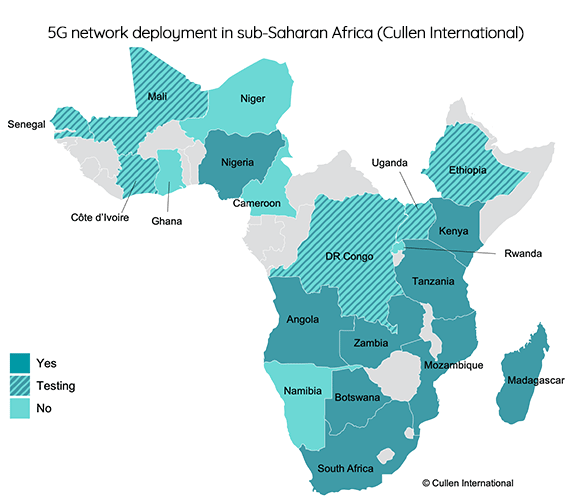
On the other hand, the promise of 5G is beginning to take shape in Africa, but it remains a story of limited deployment rather than widespread adoption. South Africa, Nigeria, and Kenya are expected to account for more than half of all 5G connections in Africa by 2030, according to GSMA. However, across much of the region, 5G remains in the trial and early rollout phase, with infrastructure, device affordability, and demand still posing major obstacles. For many telecom operators, the focus is still on expanding 4G coverage before making large-scale investments in 5G.
This makes sense: while 5G is the future, most Africans are still making the transition from 3G to 4G, not from 4G to 5G.
Why 5G Might Not Be the “Immediate” Answer
While 5G undoubtedly has its advantages, it might not necessarily be the immediate answer to Africa’s digital divide. The infrastructure demands alone pose a significant challenge—5G requires dense fiber networks, extensive tower upgrades, and higher energy consumption, all of which come at a steep cost.
As Angela Wamola, Head of Sub-Saharan Africa says in an interview with TechAfrica News, “Investment is still needed at the 4G level to support the consumer, but even greater investment is required for the future, focusing on 5G and beyond.”
Device affordability is another major barrier to its adoption. The median income in many African countries makes 5G-capable smartphones an unaffordable luxury for the average consumer. Even as prices gradually decline, the reality is that millions still struggle to afford even entry-level 4G devices, keeping next-generation connectivity out of reach for the majority.
For telecom operators, prioritizing 5G in regions where even 4G coverage remains patchy is neither financially nor logistically viable.
“I think the main challenges to rolling out 5G will continue to be the core challenges we face on our network. The cost of rolling out the network is substantial. Vodacom has pledged another 60 billion Rand over the next five years, committing about 10 billion Rand a year to the network, as we have done for the past five years. This investment is crucial, but much of what we have is imported, and the exchange rate plays a significant role in that”
– Sitho Mdalose, CEO, Vodacom South Africa
Beyond infrastructure and affordability, the practical use cases for 5G in Africa don’t yet align with the continent’s most pressing connectivity needs. While industries in wealthier nations are exploring 5G-powered smart factories, autonomous vehicles, and AR/VR applications, Africa’s digital priorities remain far more fundamental—mobile banking, e-learning, e-health, and small business digitization. Pushing 5G in markets where basic internet access is still a privilege risks creating a two-tier digital economy, where wealthier urban centers race ahead while rural and underserved communities remain stuck on outdated networks.
The real danger isn’t just slow 5G adoption but it’s rushing into 5G while millions remain disconnected or struggling on 3G. If digital transformation is truly about inclusion, then the smarter path is clear: maximize the potential of 4G first, then build towards 5G when the ecosystem is ready. Bridging the gap isn’t just about technology—it’s about ensuring that no one is left behind in the digital economy.
The Smart Approach: Advancing 5G While Strengthening 4G
Africa’s digital transformation doesn’t need to be an either-or-scenario between 4G and 5G, but rather a careful balancing act that ensures progress without leaving vast swaths of the population behind. To achieve meaningful digital inclusion, we must first expand 4G access, lower the barriers to affordability, and introduce 5G rollouts strategically—in high-demand areas while strengthening the foundation elsewhere.
To effectively tackle affordability barriers, a more coordinated approach is required, with local manufacturing playing a key role. By producing affordable smartphones within the continent, the cost of imports could be significantly reduced, passing those savings directly to consumers. Additionally, programs like Kenya’s Safaricom “LipaLater” financing plan, which allows consumers to pay for devices in instalments, can make 4G smartphones more accessible to low-income users.
“The affordability of devices is crucial, and at Vodacom, we’ve explored several solutions to address this, including our ‘easy to own’ innovation, which allows consumers to pay daily installments for a smartphone, starting at as little as 8.50 Rand per day. As you pay, it provides both data and the ability to use and unlock the smartphone.”
– Sitho Mdlalose, CEO of Vodacom South Africa
This approach should be complemented by government and operator subsidies to ensure broader affordability. Moreover, taxes on devices should be reassessed to reduce the financial burden on consumers, and the high cost of data must also be addressed to make mobile internet more affordable for all.
“If we can solve the challenge around the affordability of 4G devices, we can leapfrog even those customers still on 2G—representing the 44% who have never accessed mobile broadband—straight into 4G. This would allow them to benefit from the infrastructure that’s already developed, helping to close the gap across Sub-Saharan Africa, where there is still a long road ahead in terms of digital access.”
– Angela Wamola, Head of Sub-Saharan Africa, GSMA
But device affordability is only part of the equation. 4G infrastructure expansion is crucial for ensuring that no one is left out of the digital revolution. Many rural areas remain disconnected, not because people lack the desire to connect, but because deploying infrastructure in remote locations is cost prohibitive. Governments, alongside telecom providers, must direct more Universal Service Fund (USF) resources toward these areas, encouraging network expansion where it matters most. Universal Service Funds (USFs) in this case have largely underperformed in many African countries, with substantial portions of allocated resources remaining unspent or misdirected, hindering efforts to expand connectivity in underserved and rural areas where it is needed most.
“Insights from the GSMA report on Universal Service Funds in Africa indicate that the funds are underperforming and have become ineffective tools to close the coverage gap, signaling the need for reforms”
– Caroline Mbugua, HSC, Senior Director, Public Policy and Communications, Sub-Saharan Africa, GSMA
There is also the opportunity to repurpose existing 3G spectrum for 4G use, maximizing network efficiency and expanding coverage without requiring entirely new infrastructure. By sharing towers and collaborating with local entities, telecom companies can lower deployment costs, allowing them to focus on connecting more people, not just urban elites.
Maximizing the potential of 4G is not just about providing faster speeds; it’s about unlocking new economic and social opportunities. In agriculture, farmers can access real-time market prices and weather information via mobile phones, helping them make better decisions. In healthcare, telemedicine can bring urban specialists to rural clinics, providing much-needed expertise where it’s most needed. Education, too, stands to benefit, with digital literacy programs and e-learning platforms helping to bridge the gap for students who would otherwise be left behind. Strengthening 4G connectivity now will set the stage for future growth, ensuring that when 5G does arrive, it doesn’t just cater to a privileged few but builds on a connected base that can fully take advantage of the next wave of digital transformation.
The approach to 5G must be deliberate, not rushed. Instead of a blanket rollout, targeted deployments in specific areas—such as industrial hubs, ports, or tech campuses—where 5G can drive the most immediate impact should be prioritized. For example, in South Africa, the mining sector has already started testing 5G to enable smart mining solutions and increase safety through real-time data monitoring.
For Africa to truly benefit from the promise of 5G, the path must be inclusive and pragmatic, focused on first ensuring every African is connected to the technologies they need to improve their lives.