

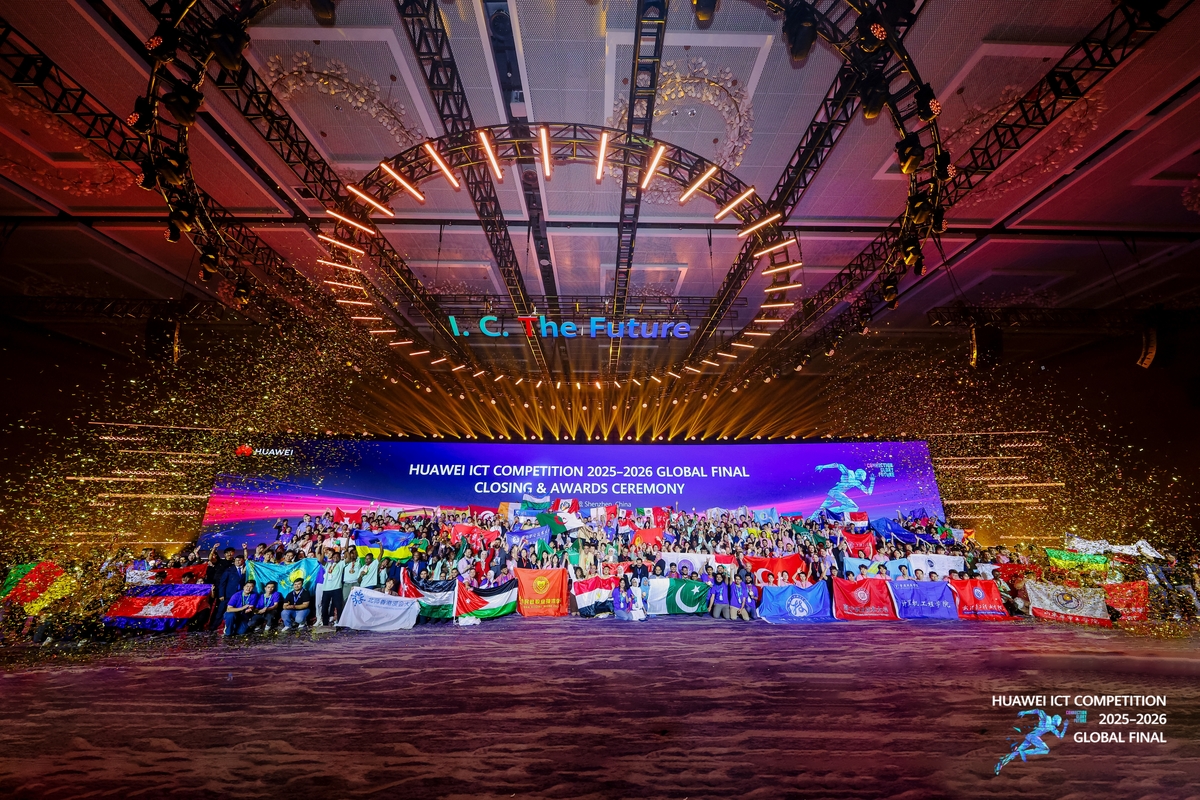
The Shenzhen International Convention Center in Guangdong Province, China, on the 4th. On the day the awards ceremony for the 10th “Huawei ICT (Information and Communications Technology) Competition” was held, following three days of preceding events, the venue was bustling from early morning with students of various skin tones and attire. Wearing matching uniforms and each holding their national flags, the students sat in the audience with elated expressions, beaming with laughter. One team from Italy, though they did not make it to the podium, approached this reporter to ask for a commemorative photo, saying they wanted to preserve the memory of the day.
Each time a winning team was called, applause and cheers erupted as if an Olympic gold medalist had just been born. Among them, the team that drew the most spotlight was the Kenyan team that won the grand prize in the cloud category. According to local media, the Kenyan team’s grand prize win was the first in the competition’s 10-year history. Before boarding their flight to China, they received a commendation from Kenya’s Minister of Information and Communications Technology, being treated as national heroes.
The Huawei ICT Competition, held from the 3rd to the 6th, has firmly established itself as a true festival for global ICT talent. This year’s competition, marking its 10th edition, drew more than 220,000 students and teachers from over 100 countries and regions and more than 2,000 higher education institutions. After qualifiers, 177 teams from 49 countries and regions advanced to the finals, and 18 teams from eight countries — China, Nigeria, Singapore, Algeria, Brazil, Egypt, Kenya, and the Dominican Republic — won grand prizes. Participants competed with ideas across various fields including artificial intelligence (AI), computing, and cloud.
Winning in the competition leads directly to a smooth career path. Advancing to research labs at China’s prestigious universities is common. This is because China’s Ministry of Education has officially certified the competition as a university student competition, allowing winners to receive bonus points when applying for graduate school. The Central China Normal University team that won third prize last year went on to graduate programs at renowned Chinese institutions such as the Chinese Academy of Sciences, Beijing Normal University, and Fudan University. Many also join Huawei. Mohammed Alkooheji, the Bahraini student who took first place in last year’s finals, recently obtained a full-time position as an internet protocol (IP) engineer at Huawei after graduation.
What stood out particularly in the competition was the advance of talent from the “Global South” — developing countries in the Southern Hemisphere — including Africa, Latin America, and Southeast Asia. This is because Huawei is actively recruiting talent from these countries that are favorable to China. In fact, the ICT Competition holds qualifiers by region, including the Middle East and Central Asia, Southern Africa, Asia-Pacific, North Africa, Latin America, and Europe. Excluding China (154,000 people), the Global South was overwhelmingly dominant, in the order of the Middle East and Central Asia (25,000 people), Southern Africa (12,000 people), and North Africa (9,000 people). Europe accounted for only about 1,000 people, and no qualifiers were held for North America at all.
There is an assessment that Huawei, a leading Chinese ICT company, is rolling out a “Belt and Road” approach in securing talent as well. Beyond the ICT Competition, Huawei has provided its practice-oriented ICT curriculum, the “Huawei ICT Academy,” to more than 3,000 universities and institutions, producing over 1.3 million students. It has also been running “Seeds for the Future,” which invites university students worldwide to Huawei headquarters to provide ICT education and networking opportunities, for more than 10 years. In South Korea, more than 7,000 students have gone through this program over the past 10 years.
Huawei provides the best environment and rewards to the talent it discovers in various regions. A representative example is the “Xicun Campus,” an R&D base in Dongguan that Chairman Ren Zhengfei, a graduate of Chongqing University’s architectural engineering department, personally participated in designing. This site, visited on the 3rd, spans a vast 1.8 million square meters — the equivalent of 250 soccer fields — where 112 buildings inspired by 12 European cities such as Heidelberg in Germany and Paris in France are lined up, creating the illusion of being at a theme park. Here, 25,000 researchers reside, carrying out various R&D centered on the device sector.
Amid its competition with the United States for technological supremacy, China is staking everything on attracting talent, with not only the state but also companies and local governments stepping in directly. From October last year, the government established the K-visa, targeting young science and technology talent holding a bachelor’s degree or higher in STEM (science, technology, engineering, mathematics) fields. By allowing individuals to apply directly without an employer’s invitation, it has significantly lowered the threshold for entry into China. Shenzhen, where Chinese tech companies including Huawei, Tencent, and BYD are concentrated, has been running the “Peacock Plan,” an overseas high-level talent recruitment project, since 2011. Through last year, it provided a total of 10 billion yuan to more than 300 startup teams, of which 12 teams successfully went public. At the same time, China is increasingly strictly blocking the outflow of its own talent abroad, imposing exit restrictions on engineers from private companies such as Alibaba and DeepSeek.
Source: www. en.sedaily.com