
Minister meets Telecoms Chamber, MNOs, NCA over fresh SIM registration and 5G rollout plans

MG_9172.jpg-scaled

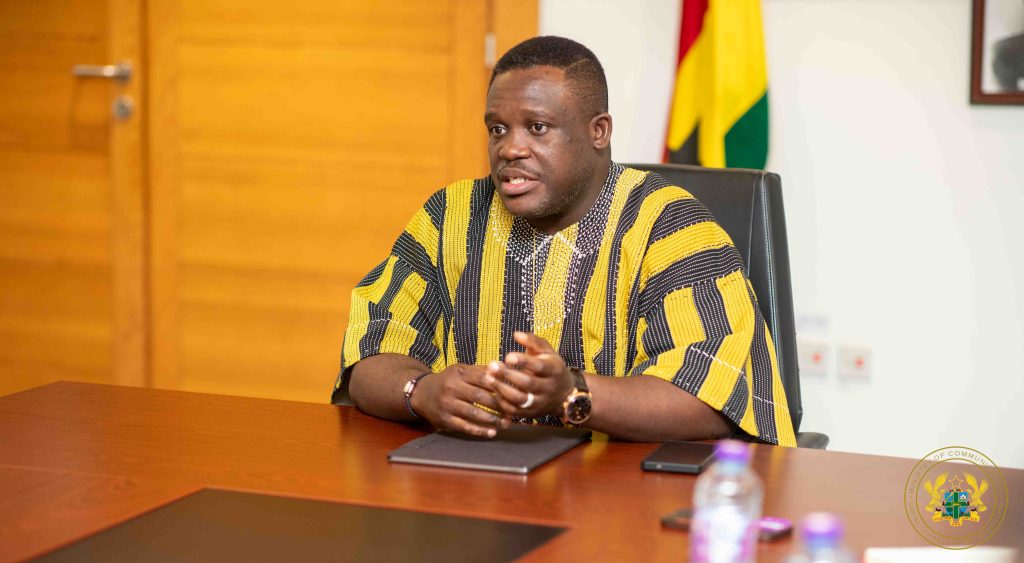
The Minister for Communication, Digital Technology and Innovations, Samuel Nartey George, has held high-level talks with the leadership of the Ghana Chamber of Telecommunications, Chief Executives of MTN Ghana (Stephen Blewett) and Telecel Ghana (Ing. Patricia Obo-Nai), as well as leadership of the National Communications Authority (NCA), to deliberate on the announced new national SIM registration exercise and the roadmap for 5G deployment in Ghana.

The meeting, also attended by the CEO of the Ghana Chamber of Telecommunications, Sylvia Owusu-Ankomah, NCA Director-General Rev. Ing. Edmund Yirenkyi Fianko and senior Ministry and NCA officials, focused on Cabinet-approved reforms aimed at strengthening national security, improving quality of service, and accelerating Ghana’s digital transformation

Fresh SIM registration exercise approved

Addressing participants of the meeting, the Minister disclosed that Cabinet has approved the completely new SIM registration exercise following what he described as an extensive review of the previous process.

According to him, the earlier exercise suffered significant challenges, including weak biometric enforcement, data inconsistencies, and registration fraud among others. He stressed that the new approach would not be a continuation of the old system but a reset designed to ensure credibility and security

Under the new framework:

  • The NCA will serve as the central repository of SIM registration data.
  • Biometric verification will be mandatory.
  • A Central Equipment Identity Register (CEIR) will be introduced to enable cross-network blocking of stolen or fraud-linked devices.
  • A revised Legislative Instrument (L.I.) is being prepared to regulate back the exercise

Industry leaders, while supporting the objective of strengthening the system, raised some operational concerns.

5G policy reset and spectrum auction

On 5G, the Minister revealed that Cabinet has approved the removal of the exclusivity clause under the previous wholesale 5G framework, paving the way for a new competitive spectrum auction process

He clarified that the wholesale model has not been cancelled but that the new framework will allow network-based rollout, with the objective of ensuring universal deployment across operators.

Among the key highlights:

  • A new 5G spectrum auction is expected to be concluded soon.
  • The rollout is expected to be coordinated to prevent market distortion.

Industry leaders underscored the capital-intensive nature of 5G, noting that deployment will require significant spectrum acquisition costs, network upgrades and infrastructure expansion. They called for reasonable pricing, predictable policy direction and streamlined regulatory approvals to enable rapid deployment.

Collaborative path forward

The meeting concluded with agreement on structured technical engagements between the Ministry, NCA, Telecoms Chamber and operators to refine implementation modalities for both the SIM registration exercise and the 5G auction framework.

Immediate next steps include finalising the revised L.I., and publishing auction documentation.

The engagement signals what participants described as a renewed collaborative approach between government and industry as Ghana prepares for a new phase of digital regulation and next-generation connectivity.

Telecom Industry Leaders Pledge Support to New Communications Minister Samuel George

WhatsApp-Image-2025-02-26-at-19.59.25

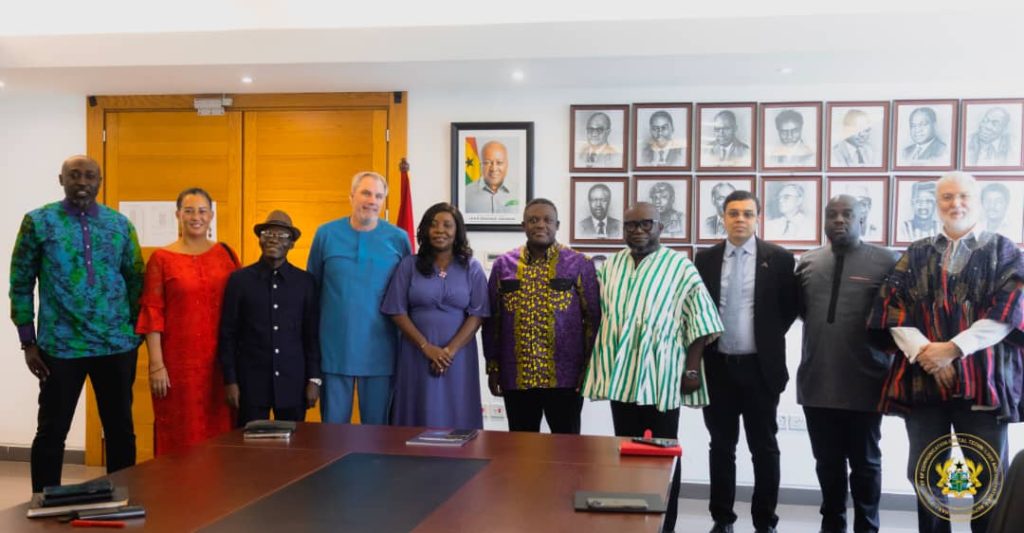
Accra, Ghana – The leadership of the Ghana Chamber of Telecommunications and its members have paid a courtesy call on the newly appointed Minister for Communications, Digital Technology, and Innovations, Samuel Nartey George, to congratulate him on his new role and offer their full support in advancing Ghana’s digital economy.

The meeting, held at the Ministry’s offices in Accra, provided a platform for engaging discussions on key industry challenges, policy directions, and opportunities for collaboration between the government and the critical telecommunications industry. In attendance from the Chamber were all the CEOs and country managers of MTN, Telecel, AT, ATC, Helios Ghana, CSquared, Ericsson and Huawei. The Minister was accompanies by some of his leadership team as well as the Acting DG of the NCA and some of his leadership team members.

Telecom Industry Lays Out Key Concerns

During the engagement, the Chamber and its members—comprising Ghana’s leading telecom operators and service providers—highlighted several critical issues impacting the industry. These included but are not limited to the following:

🔹 Protection of Telecom Infrastructure – Members expressed concern over the rising cases of fibre optic cable cuts, theft of telecom batteries, and vandalism of critical infrastructure, which have disrupted services and increased operational costs.

🔹 Access to Telecom Sites – The industry highlighted challenges with local chiefs and landowners demanding excessive fees or blocking access to telecom installations, leading to service disruptions and higher costs.

🔹 High Taxation on the Sector – The Chamber noted that telecom companies pay over 42% of their revenue in taxes, levies, and fees, and urged the government to review sector-specific taxes to encourage investment and affordability for consumers.

🔹 Spectrum Allocation & Network Congestion – The telecom companies appealed for additional spectrum releases to address increasing data demand, improve service quality, and expand connectivity nationwide.

Minister Samuel George Commits to Strong Collaboration

In response, Hon. Samuel Nartey George reaffirmed his commitment to working closely with the telecom industry to address pressing concerns and advance Ghana’s digital transformation agenda.

“We recognize the critical role of telecommunications in Ghana’s economic development. Our focus is to build a digital economy that benefits all, and we will ensure that the industry has the necessary support to thrive,” he stated.

The Minister outlined several key action points for industry collaboration. Below are a few:

  • Regular Engagements – He assured the Chamber that the Ministry will hold and also facilitate regular formal engagements with key stakeholders to maintain open communication and collaborative problem-solving.
  • Infrastructure Protection Laws – Hon. Samuel George expressed strong support for drafting and enforcing harsher penalties against fibre optic cable vandalism and telecom equipment theft among others.
  • Industry Support for National Digital Programs – The Minister urged telecom operators to play an active role in the government’s “One Million Coders Program”, which aims to train Ghanaian youth in digital skills and software development.

Industry Optic Fibre Minimum Specifications and Standards Manual


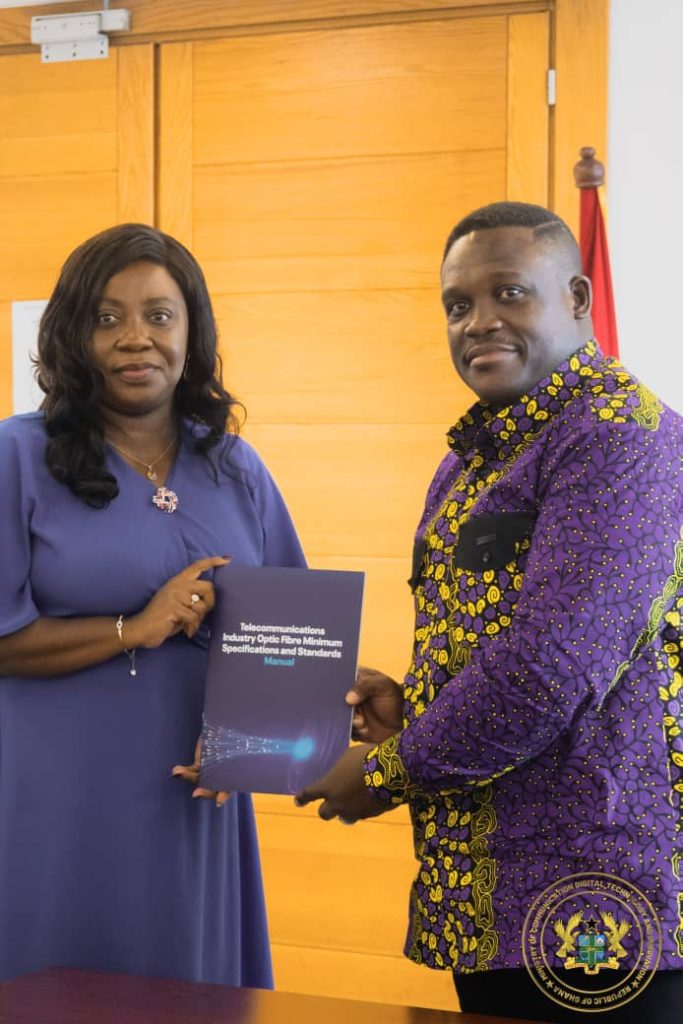
The leadership of the Chamber, went on to present a copy of its Telecommunications Industry Optic Fibre Minimum Specifications and Standards Manual which sets out the minimum industry specification and standards for the deployment of fibre optic cables in Ghana. The self-regulatory document was developed by benchmarking industry standards from Europe, Egypt and countries with successful fibre deployment systems and the experience of the Ghanaian operators.

On his part Hon. George, assured the Chamber that the standards will be carefully considered by the NCA and incorporated where possible into the Authority’s standards going forward.

A Shared Vision for Digital Growth

The Ghana Chamber of Telecommunications welcomed the Minister’s vision for the sector and pledged its commitment to supporting national digitalization efforts. The Chamber’s leadership assured the Minister that they would work collaboratively with the government to drive technological innovation, enhance digital infrastructure, and support policies that foster economic growth.

As Ghana continues to navigate its digital transformation journey, this meeting marked a crucial step in aligning the goals of government and industry to build a more connected, inclusive, and competitive digital economy.